
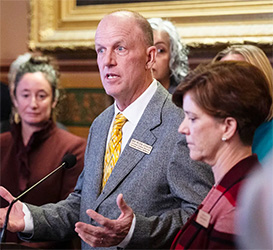

MONTPELIER – Rep. Peter Conlon, D-Cornwall, the House Education Committee chair, on Thursday introduced the first concrete proposal presented this legislative session to consolidate Vermont’s dozens of school districts.
The proposal would merge the state’s 119 districts and the 52 entities that govern them into 27 supervisory districts, each with student populations between 2,000 and 4,000, Conlon said.
The proposal would end non-operating districts, discard supervisory unions in favor of supervisory districts and introduce an updated statutory framework around Vermont’s school choice system.
The map, by Conlon’s own admission, is “faulty” and “fraught with political decisions.” But he told fellow committee members the proposal was “not meant to be the end-all be-all.”
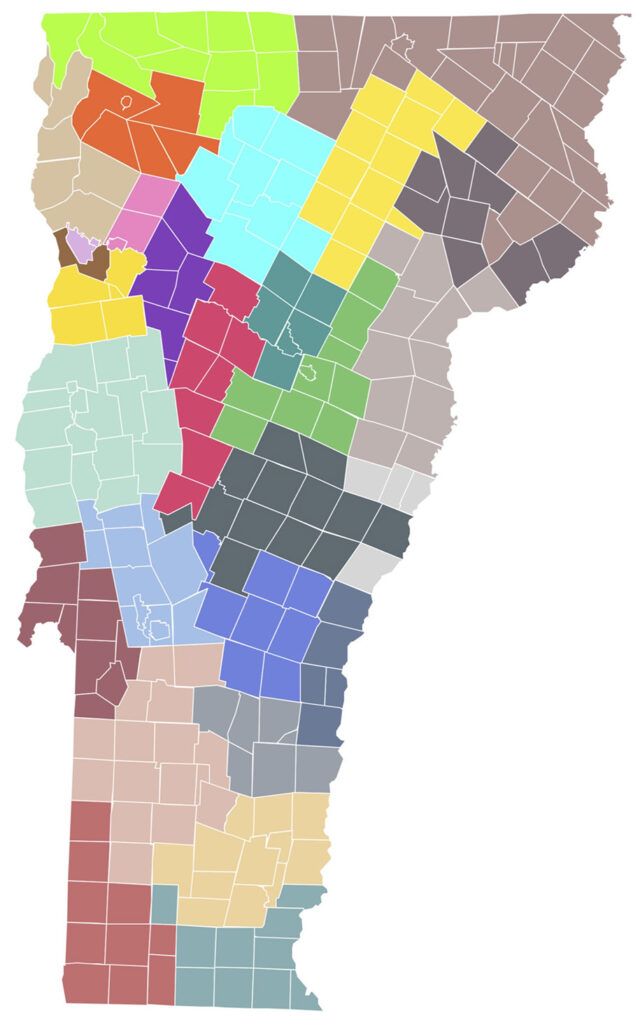
courtesy of the Vermont Legislature
“It’s not perfect, and it’s meant as a starting point, not an ending point,” he said. “But even more so, the point is really to give us something to say, ‘Oh, I can get behind this concept.’”
Rep. Leanne Harple, D-Glover, questioned whether small schools in her Northeast Kingdom district would still be viable under the proposal, a sentiment echoed by various school district officials and rural schools advocates over the past several months.
Conlon’s proposal signals a ramping up of lawmakers’ efforts to garner some consensus around school consolidation, set in motion last year by the state’s sweeping education reform law, Act 73.
Those efforts hit a speed bump in the fall, when the school redistricting task force, directed by lawmakers to draw up maps last summer, flouted that directive and instead issued a proposal emphasizing voluntary mergers with school construction aid incentives.
Gov. Phil Scott, Vermont Agency of Education officials and some top lawmakers say consolidation is critical to achieving more equity across Vermont’s public school system, and is a crucial prerequisite to establishing a new education finance formula. The legislature needs to agree on a map of consolidated school districts this year, proponents say, or risk delaying Act 73’s reforms significantly.
Concerns have emerged around the feasibility of travel times for students in more rural areas under Conlon’s proposed districts. Not to mention, the map’s districts fall below the 4,000 to 8,000 students per district that Act 73 suggests.
“There’s a huge difference between clicking on towns and actually driving across counties,” Harple said Thursday. “When we think about getting up to 2,000 (students), that’s a farther distance for the people living there than you realize.”

photo by Glenn Russell, VTDigger
Conlon noted those concerns on Thursday. “This is what could be, using the testimony that we have heard,” Conlon said. “But it is not meant to say, ‘This is what should be.’”
Notably, Conlon’s proposal introduces tweaks to state statute around Vermont’s school choice system.
The proposal keeps some of the current language, but introduces new parameters. Under the changes, school districts would assign a designated public or private school for each grade if there is no “reasonably accessible public school” operated by the district.
School districts would have to enter into a contract with receiving schools, be they public or private schools (called independent schools under state law).
Those schools would have to adhere to a host of requirements. Schools would be required to send progress and attendance reports to the primary district, for example.
Schools under contract would also be prohibited from conducting mandatory interviews and academic entrance exams, or charging students application or academic fees during the admissions process.
The policy changes, Conlon said, are an effort to respect “the fact that we need our historic academies” while also “pulling the state out of this complicated choice situation.”
Policy changes would also open the door for districts to utilize cooperative service agreements, regional entities endorsed by the school redistricting task force that allow districts to share services like special education, transportation, business and administrative services and curriculum development.
The committee will continue to take testimony from experts and from public education officials, Conlon said Thursday.


