
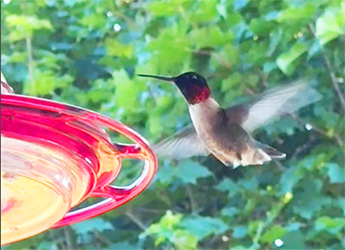



SOUTH BURLINGTON – It is hard not to watch in amazement when seeing a hummingbird flitting around.
These iridescent beauties with their acrobatic flight movements are reminiscent of fairies. Thankfully, with a few purposefully chosen plants, gardeners can convince these adorable birds to spend more time in a garden.
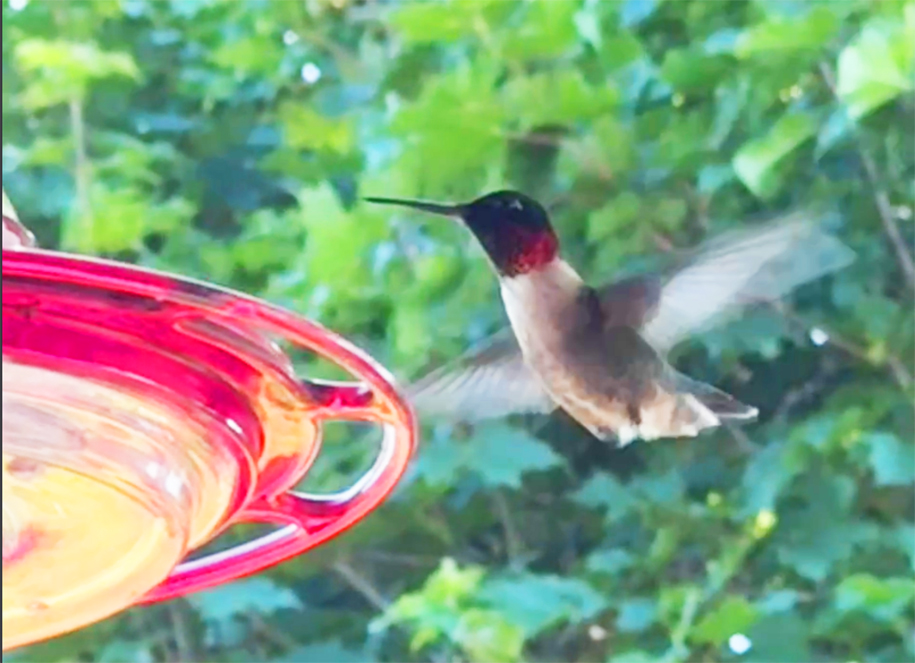
photo by Debra Heleba
Hummingbirds are named for the humming sound that their wings make when they are in flight. Although there are over 330 species of hummingbirds in North and South America, the only species that can be found east of the Mississippi River is the ruby-throated hummingbird.
Measuring three to four inches and weighing a mere 0.2 ounces, these little wonders make a 600-mile non-stop migration in September from the Northeast across the Gulf of Mexico to Mexico and Central America. By May, they arrive back in the Northeastern United States, feeding on the nectar of azaleas, rhododendrons, columbine and flowering trees.

The hummingbird builds its tiny nest on small limbs of trees or shrubs five to 20 feet above the ground. They prefer locations that are above a source of water, a trail or other open area. When choosing trees, they select those with rough bark or bark covered in lichen. Once a nesting spot is established, the female hummingbird will return to the same nest or build a new nest in the same tree or shrub, year after year.
A typical hummingbird diet consists of nectar from flowers, insects, spiders and sometimes sap from trees, if a woodpecker supplied a hole for them. They will also happily feed on the sugar-water solution in feeders provided by us humans.
Hummingbirds lack a strong sense of smell, so they are instead attracted to flowers based on color. Red, orange and pink flowers are the most noticed but they will, of course, eat nectar from flowers in other colors. Their long beaks and tongues enable them to access the nectar in tubular-shaped flowers.

photo by Debra Heleba
At least 19 species of locally-evolved plants rely on hummingbirds for pollination. Some examples include jewelweed, trumpet vine, cardinal flower, trumpet honeysuckle, fire pink, columbine, and wild bergamot.
To encourage hummingbirds to come to a yard, plant a variety of flowering plants that will provide nectar from early spring through fall. A full season buffet might include Virginia bluebell, followed by lilacs and Sweet William, and then finishing up with penstemon, geranium and dahlia to nourish them until they are ready to return south.

photo by Amy Simone
Most importantly, avoid the use of herbicides and pesticides. Herbicides can be ingested through the plant’s nectar, sickening or even killing hummingbirds. Insecticides may deplete the population of insects that they like to feed on.

photo by Debra Heleba
If providing a sugar-water solution in a hummingbird feeder, take care to prepare the solution properly. Boil four parts water and pour over one part sugar, stir, then cool to room temperature before pouring into the feeder. A weaker solution will not be attractive, and a stronger solution may harm them. Never feed honey, since a fungal disease from fermented honey can kill the birds.
Place the feeder safely outside of the pouncing distance of cats, and be sure to replace the sugar solution and clean the feeder thoroughly every three to five days.
Once having successfully attracted the ruby-throated hummingbird to a yard, sit back and enjoy their beautiful show.
Amy Simone is a UVM Extension Master Gardener volunteer from South Burlington.

Amy Simone
Amy Simone is a UVM Extension Master Gardener from South Burlington.

