
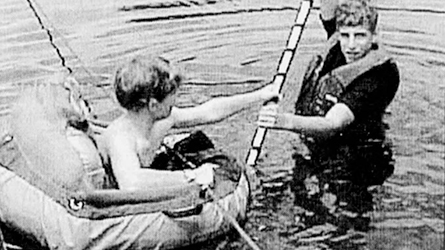



25 years ago in The Hardwick Gazette

Summer STARS Deep Into Water
by Kelly E. Papke
HARDWICK — Hazen Union School students work on implications of the Jackson Dam.
The Summer STARS-Students and Teachers Achieving Results and Success, will submit computer presentations to the select board.
Each report will contain digital camera pictures and other data the students scanned, said Hazen Science Teacher Eli Rosenberg.
Reporting to the community, research, and following a curriculum are the three goals the program focuses on, Rosenberg said.
“No one is going to say as a group whether it stays or goes,” said Rosenberg about the dam.
Summer STARS is a summer school program for students to meet grade requirements. Most of the students chose to be there. Their ages range from 12-15. They attend either Hazen or Craftsbury Academy.
“By fall we should have enough documentation to share with the public in one or a series of public meetings,” Vermont Natural Resources Council Project Manager Kim Kendall said.
VNRC offered to help fund studies and the possible removal of the dam, so rate payers of the Hardwick Electric Department do not have to foot the bill.
Kendall has been working with the teachers but not the students yet. She has helped plan activities around some of the data VNRC already has.
“Kim gave us a lot of primary documents,” Rosenberg said.
She gave the group a dam safety report from 1993 and other studies already done, said Rosenberg.
Kendall talked about sharing her knowledge with the students as a slide show, but has not made arrangements for that. “Any information they can generate that we don’t have will be really useful and I think this is one of our goals,” Kendall said. “Whether the decision is to keep or remove the dam, it gets students and the public talking about the river.”
This day the 17 students will participate in a game to teach them about the life cycle of a salmon. Fridays are often a day for fun activities, said Rosenberg.
Rosenberg proceeds to debrief the STARS on the obstacles a salmon passes through to get back to the place of its birth.
Everyone knows the answers to his questions, but they raise their hands instead of shouting out.
Bears, eagles, other fish, drying up, buried by dirt, turbines, sludge, toxic chemicals, still water, fisherman and dams are among the answers.
After four to six years a salmon stops eating, turns around, and heads back upstream because it’s time to breed, said Rosenberg.
The fish jump upstream over dams, up waterfalls, and past bears waiting for them.

Once the fish reach their place of birth, they lay 1500-7000 eggs when they burrow the pebbles.
“How many eggs survive?” said one boy.
“That’s a good question,” Rosenberg answers.
That is where the game Hooks and Ladders comes in. The students start wondering about the Lamoille River.
The river had a salmon run in the past but the dams down the Lamoille prevent this.
Everyone travels outside to play the game.
They pass through jump ropes that symbolize turbines and players acting as bears. In the end, after obstacles, only a few players survive. This shows that not too many eggs make it through.
“Two weeks ago they put down interests and helped mold them into groups,” said Rosenberg.
One group focuses on flooding.
“Does the dam help prevent flooding and what will happen if it goes away,” Rosenberg said.
The second group studies how the dam affects the shape of the river.
This group takes pictures of the bottom of the river.
They also study the reaches to see where the silt goes and where the natural channel is located.
Another group is concerned with the value of the dam to the community. They are going around town with surveys. The fourth group focuses on the ecological effects the dam has on the community.
“It (Summer STARS) sounded cool and I could learn a lot,” said Hazen student Lori Martin. “I am studying the shape of the river.”
Martin said her group has made numerous phone calls and looked up information on the Internet.
“I went on the bottom and took pictures,” said Hazen student Ryan Sanders. “Down by the dam there is more silt.”
Silt and mud are not good for fish, especially spawning fish, because they need gravelly streambed.
Martin said her group found the term “thalweg” online, which is the part of the river that runs the fastest. They have not determined where this is on the Lamoille.
Sanders said he has learned a lot about salmon, but when the group went fly fishing last week, they did not catch anything.
“It’s a lot harder than regular fishing,” said Martin.
The group called the North American Hunting Club to ask for maps above the Lamoille but they did not have any.
“Everyone is learning tons of stuff and having fun at the same time,” Martin said.
The program is sponsored by Hazen and the three-year Orleans Southwest Supervisory Union 21st Century Grant that took effect June 1, 2001.
The department of education grant in the amount of $1.2 million allocates money throughout the school system for programs to enrich students.
The 21st Century Learning center is establishing a vision for the grant, said director Eileen Boland. “It is a big amount of money for the community so we have to be really strategic about it,” Boland said. “This is not just a program. This is a movement.”
With the grant, after-school programming is here to stay, said Boland.
The grant is seed money to start programs that may be sustained by other funding after the grant expires.
“There is a mix of improving academic and providing real life opportunities,” Boland said about the STARS program. “Those kinds of opportunities are really important for young people. They are the next adults in our communities.”
Boland said the 21st Century site coordinators have a lot of work ahead of them to develop ways to keep the grant in the community.


