


HARDWICK – The Center for an Agricultural Economy (CAE) has produced a video titled, “Atkins Field: A Community Site of History and Future Participation.” It tells the story of Atkins Field through video footage, current and historic photos and comments from young and old community members. And, despite funding challenges, a solar array planned for the new Food Hub building will be built.

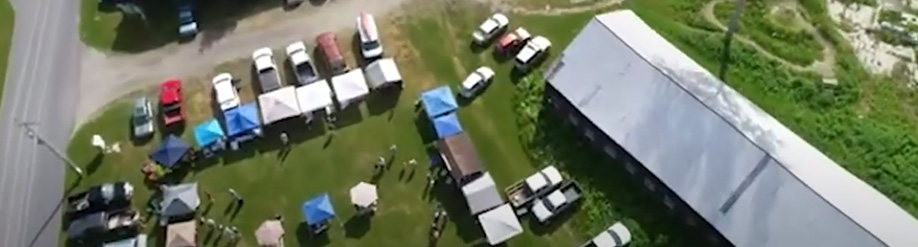
courtesy photo from Atkins Field video footage
“The video focuses on Atkins Field past, present, and future. From youth to elders, intergenerational connection and a deeper connection to the land through the use of Atkins Field, is helping redefine and encourage future visions.,” noted a CAE newsletter announcing the release of the video Sunday.
“Atkins Field is a dynamic community gathering place in Hardwick, Vermont,” said the announcement. “It is stewarded by the Center for an Agricultural Economy, and has served different purposes over the years including being the site for community celebrations, the Hardwick Area Farmers Market, community gardens, a small orchard, and pump track, among other uses.”
While the field flooded in July 2023 and 2024, due to its proximity to Cooper Brook, which overflowed its banks, the relatively new pavilion there weathered both storms, but portions of the community garden have been moved to an area behind Hazen Union School. “. . .That has spurred a call for rethinking how best to use this space,” said the CAE.
The CAE’s Executive Director Jon Ramsay shared news that the organization has made a “continued commitment to completing the renewable energy project at the Food Hub despite the loss of $250,000 in previously secured federal grant funding for the solar array. The solar array will provide long-term environmental benefits and play a crucial role in the sustainability of this critical new piece of local food systems infrastructure. It will also help keep costs down for the farms using the facility; a direct benefit to their operations. It marks an important milestone in CAE’s commitment to being a good steward of the land.”
Ramsay reports that $400,000 in previously awarded federal grants have been determined since January 1. That included $100,000 for the CAE’s Community Connections work and $50,000 for Farm Connex, in addition to the $250,000 for the solar array.
“These losses are significant, and they reflect only one organization’s experience. While the loss of funding has forced us to reexamine and adapt some of our programs, the work will continue, even if it looks a bit different than in years past. That continuity is made possible in large part by the strong local relationships that sustain and support us,” said Ramsay.
“CAE’s programs and facilities directly impact thousands of people,” wrote Ramsay.. “Hundreds of jobs and over $20 million dollars of local economic activity is generated from CAE’s work annually. This is why, despite these challenges, CAE continues to support the people, farms, and food businesses who rely on our services.
“We will keep building strong relationships and working alongside those committed to local, community-based solutions,” concluded Ramsay.
The new video was created in collaboration with Martha Caswell and Katie Horner, video by Elizabeth Rossano Films, drone footage by Kyle Gray and content from Hardwick Community Television. It was edited by Myles David Jewell, with graphics by Peltz Creative. CAE staff involved in the project were Bethany Dunbar, Reeve Basom, Hayley Williams, Lylee Rauch-Kacenski, Kelly Stokes and others.
The video came about through a two-year partnership funded by a grant from the Leahy Institute for Rural Partnerships, which helps to create university-community partnerships to benefit rural places. This project involved the CAE; Northeast Kingdom Organizing (NEKO), Rural Vermont and The University of Vermont’s Institute for Agroecology (IfA)
Learn more about the CAE and the video at hardwickagriculture.org.

Paul Fixx is editor of The Hardwick Gazette and lives in Hardwick.


