


GREENSBORO – Voters at Greensboro’s special town meeting Tuesday evening, June 30, rejected the petitioned articles to move financial and public questions to Australian balloting.
In a vote of 101 to 77, voters said no to Article 1: “Shall the Town of Greensboro adopt all budget articles by Australian ballot?”
Quite a few voters had left before voting on the second question began by paper ballot. That vote was 85 against and 59 in favor, with even fewer returning to their seats to hear the result of the vote on Article 2:” Shall the Town of Greensboro vote on all public questions by Australian ballot?”
Greensboro Town Moderator Mavis MacNeil, newly elected at the March town meeting, began the special meeting introducing herself, spelling out ground rules for the meeting that included following Robert’s Rules of Order, except here state law modifies them, and limiting comments from voters to two minutes.
After reading the articles, Gary Circosta made a motion to accept the first and his wife Renee seconded it.
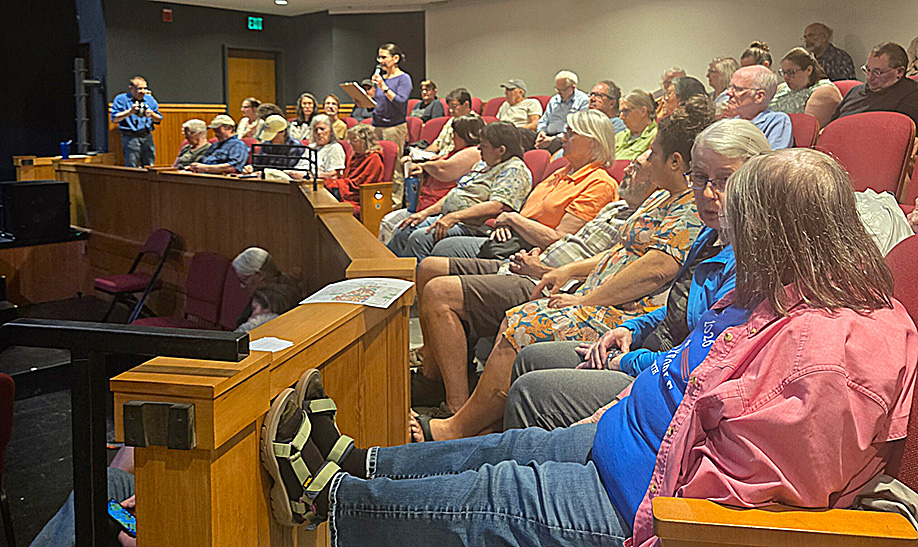
photo by Paul Fixx
Gary was recognized first, beginning, “Here’s what these Australian ballot issues boil down to. People who are able to attend long in-person town meetings are being asked to accept a little change so that all voters have a realistic opportunity to vote.” He continued for his allotted two minutes, emphasizing the number of voters who had signed the petition (107, 15% of those eligible to vote), the message sent to those who cannot attend an in-person meeting and the number of towns using Australian ballots to elect officers (almost 70%), approve budgets (almost 40%) and consider public questions (about 45%).
He emphasized the importance of a secret ballot to allow freedom from outside influence.
When Gary’s time was up, he asked to share one more thing, but MacNael said, “Nope,” and recognized Renee, who said she intended to continue with Gary’s statement, but first called for paper ballots for the Article 1 vote.
The necessary seven voters were found to support the call for a paper ballot and Renee continued. Noting the fight for women’s suffrage and the recognition “that democracy is stronger when more voices are heard.”
Janet Long called the proposal “a rather drastic and fast change to what we’ve known and other towns had more time to discuss it, and then decide on it. So, I am voting no on this proposal.”
Bridget Collier was up next, noting “town meeting has been going on in New England for over 200 years.” The town meeting allows changes to budgets that are not possible with Australian Ballot, she said, and added that the number of people voting for school budgets dropped off when that vote moved to an Australian ballot.
Megan Meacham said she had not been able to attend the usual Tuesday town meeting because of her teaching schedule, suggesting alternative structure of an Australian ballot would give agency to herself and others.
Penny Bretschneider said, “I think we should do both, and I think it’s hard work to do both.” She suggested a blend would offer an advantage, with a vote after a town meeting, Australian balloting would cause community expertise to be lost, so she recommended a hybrid approach be developed.
Jed Pfeffer began with a question about how being able to change a budget in town meeting could lead to an Australian Ballot. Greensboro Select Board Chair MacNeal responded to say, an Australian ballot cannot follow a town meeting.
Conversation about how an informational meeting could be held more than 30 days prior to the Australian ballot warning then happened, with Valdine Hall using her time to further clarify how the select board could take suggestions on the budget, then discuss them at a warned select board meeting at which changes might be made prior to the Australian ballot warning.
Select board member Tim Brennan discussed an option in New Hampshire where an early meeting by voters controls what ends up in the budget earned for an Australian ballot vote.
Select board member Ellen Celnik pointed out that budget discussions happen weekly, leading up to several sessions for voters to learn about and comment on the budget. She further said the select board was open to improvements in the process to allow more voter engagement.
David Kelley said he agreed with the Ciscostas about creating more opportunity for voter participation in the town’s decision making process. “The are lots of ways we can do that,” he said. Informational meetings are not the way to do it.
He then moved to table the motion and establish a committee to study the issues. After Mavis consulted with former Town Moderator Tim NIsbet, Kelley’s motion received a second. A point of order comment by Gary Circosta suggested the motion was not germane to the issue, a response by Nisbet was followed by clarification by Karl Steins.
Mavis then ruled the motion not germane and out of order.
Alice Perron made note of anonymous information distributed about previous town questions.
Carolyn Kehler returned to Kelley’s motion, suggesting Robert’s Rules of Order allow anything to be returned to committee, asking Mavis for clarification of her interpretation, who said he had asked an attorney with the Vermont League of Cities and Towns the exact question, who said referral to committee is too far afield from the original motion to be germane.
Others shared their thoughts, including Naomi Ranz-Scheifer; Tim Nisbet, who asked the select board to set up a committee of town voters to explore options that might include electronic voting with a clicker system, and have the report ready by November 1.
Charlie Pete was recognized despite not being a voter and said “New Yorkers would love the power of the citizen legislature” offered by the Vermont town meeting.
Karl Stein, tackled about charts he had displayed before the meeting showing engagement at town meetings vs. Australian ballot;
Hal Gray, said town meetings had to survive in some fashion; Susan Schulman, talked about “the tremendous value,” of meeting in-person and the haste of the proposed motion, “What’s the hurry?”
Jackie Ramsay-Tolman thanked the select board for the transparent process they use for budgeting.
Mateo Kehler said, “The effect of Australian ballot power is what draws citizens to participate. Sancy McCloud and Warren Hill spoke too before Nancy Lammert called the question to bring on the paper ballot voteMavis explained the paper balloting process, which began over an hour into the meeting.
After the results were announced by Mavis, voting down Article 1, Mavis asked the select board to clarify what the effect of Article 2 would be. MacNeal went through the recent town meeting warning to identify the public questions that would be affected by moving them to Australian balloting.
Gari Circosta again began, making the case for a vote for the motion to implement Australian ballots for public questions.
Kathy Newhouse said she wears hearing aids and reads lips, but only picks up 50% of the meeting. “So, I’m begging you people, please give me a chance. I can’t sit here all night and be completely frustrated, having no idea what you’re talking about, but I’d really like to have a say. . . Give us Australian ballots,” she said.
Others spoke, saying much the same things as for the first article, with impassioned arguments being made on both sides of the vote.
Tim Nisbet added another comment about the voting clockers to say 200 of them would cost $10,000 and carry no future fee.
A question about the select board’s seemingly changed stand on having a committee to explore future options for soliciting input and votes from town voters by Renee Circosta brought comments that board members are seeing the desire of voters and responding to it.
The vote on the failure of Article 2 to p[ass was announced by Mavis and the meeting quickly adjourned, note long before 9:30 p.m. roughly three hours after it began.
The meeting that began at 7:01 p.m.quickly adjourned after that, near 9:30 p.m. The two paper ballots had taken approximately one hour, with the first taking longer, because of the 178 vs. 144 votes in the second.

Paul Fixx is editor of The Hardwick Gazette and lives in Hardwick.
