

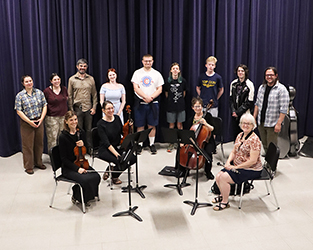

GREENSBORO – The second concert of the Summer Music from Greensboro series saw a return from last year’s season of the very popular Manhattan Chamber Players, with a program of three relatively short pieces by Mozart spanning his life and then a monumental “String Quartet in C Major” by Schubert, one of his last compositions. Performing in the acoustically excellent sanctuary of the Greensboro United Church of Christ, they brought an admirable enthusiasm and immediacy to these works that resonated deeply in the sophisticated audience.
All the musicians in this group have impressive credentials in their education and extensive experience in concerts in this country and around the world, and their ensemble effect was electrifying, both in their exacting technique and feeling interpretations. Siwoo Kim and Grace Park were on violins, Tanner Menees on viola and Andres Janss and Brook Speltz on cellos.
Wolfgang Amadeus Mozart (1756-1791) wrote an astonishing number of works (almost a thousand pieces in widely different forms) during his short life, demonstrating the characteristic endless energy of true genius. The program began with his “Duo for Violin and Viola in G major
K. 423,” written in his middle period (1783), featuring Siwoo Kim on violin and Tanner Menees on viola. Commencing with an Allegro in a fast tempo, this was indeed an intimate musical conversation between the two instruments, with intertwined melodic lines in precise coordination and vigorous bowing. The graceful theme imaginatively explored with one instrument starting a phrase while the other completed it, all with a fine drive. The Adagio that followed had a more restrained, measured pace, the tune shared alternatively paralleling and echoing each other. The final Rondeau Allegro had particularly memorable melodies, with two themes given playful variations, which Kim and Menees performed with total engagement in their musicianship.
The “Theme and Variations from Divertimento for String Trio in E Flat Major K. 563,” was written towards the end of Mozart’s career (1788), and was played by Kim and Menees joined by Andrew Janss on cello. Here Mozart gives six permutations on the initial tune in a kind of democratic scoring that spotlights the possibilities of each instrument in the trio with daring elaborations, reinforcing the harmonies, and hardly pausing between the movements.
The “Divertimento for String Quartet in D Major, K. 136,” comes from an earlier period (1772), with Grace Park on violin and Brook Speltz on cello augmenting Kim and Menees. The opening Allegro took right off full force with the two violins playing in lively cooperation. Then a slower tempo with gentler rhythms was juxtaposed in the Andante of the second movement. The final Presto had another fine melody with some counterpoint in different voices as well as a great attack in the dramatic bowing. What a high energy performance.
Franz Schubert (1797-1828) had many tragedies besides his premature death, above all, the lack of recognition beyond a close circle of friends in Vienna for the great beauty of his numerous compositions, many of which he never even heard performed in his lifetime, which now are considered major contributions to the repertoire of classical music. His “String Quartet in C Major, D. 956, posthumous 163,” was composed in the last year of his life, and was unknown and unpublished until the early 1850s. All five musicians of the Manhattan Chamber Players were involved here with the addition of a second cello to the usual quartet.
It is a work on the scale of Bethoven’s late quartets, taking us to another world, as do all great works of art, with many transcendent moments, a true journey, where alternating light and
darkness, joy and sadness, are a continuing metaphor through music for human life. The Allegro ma non troppo began with an exquisite melody and an equally beautiful second theme, which changed in their development, repeated but with varied notation. The Adagio had a slower momentum, with suite a bit of pizzicato textures on the first violin and cello. The third section, Scherzo-Presto-Trio Andante sostenuto, had a distinct change of mood, more foreboding, with pauses to the flow, short but powerful silences evoking intense emotions in the development of the themes. The closing Allegretto shifts the ambiance again to vibrant rhythms, perhaps from Austrian folk dances, more celebratory in complex sonorities among the instruments in two engaging themes.
The players certainly made this music breathe and sing right through to the great ending, and deserved a well-earned standing ovation from the very appreciative audience.

David K. Rodgers
David K. Rodgers is a writer, mason and card carrying dilettante, who dabbles and babbles in art. He has lived in East Craftsbury for the past 40 years.


