



courtesy photo
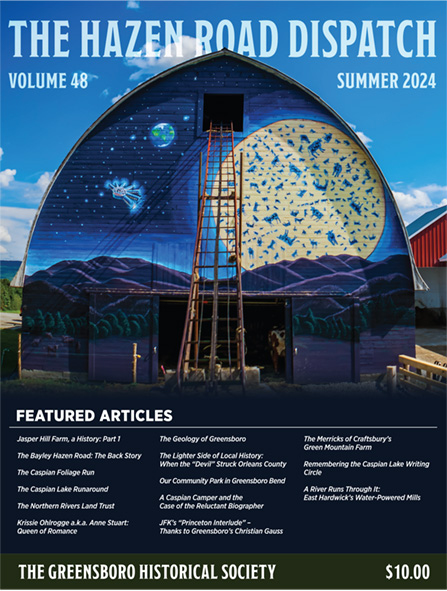
The cover of the summer 2024 Hazen Road Dispatch was designed by Sameul Rheaume and features a mural by Tara Goreau on a barn at Jasper Hill Farm in Greensboro.
GREENSBORO — This summer’s annual issue of the “Hazen Road Dispatch” published by the Greensboro Historical Society is immediately attractive by its colorful cover, designed by Samuel Rheaune, showing the beautiful mural at one end of the barn at Jasper Hill Farm, painted by Tara Goreau. Inside, the 16 articles cover an interesting variety of historical topics about Greensboro, Craftsbury, Hardwick and the surrounding area.
The edition begins with an extensive overview (Part One) by Mateo Kehler of the origins of Jasper Hill Farm. He and his brother, Andy, spent summers in Greensboro growing up, then returned to work there as carpenters. But had a deeper vision of making fine cheeses first from sheep and then from cows. They bought an old farm in 1998 and, after overcoming many financial obstacles, came out with their first cheese, Constant Bliss, in 2003.
A relationship with Cabot Creamery and some small farm producers to age their cheeses helped spur growth which, along with their own expanded line of world class cheeses, developed national customers at stores and restaurants, putting Greensboro on the map for cheese lovers.
It is an impressive record of persistence and hard work with an underlying commitment to excellence. Part Two will be about their building state-of-the-art cheese aging cellars.
The next article, by Mark Bushnell, gives a fascinating account of the Bayley-Hazen Road. The road began being constructed in 1776 in Wells River on the Connecticut River and went 57 miles through dense forest to Hazen Notch, west of Lowell. Originally intended as in invasion route to Canada for American Colonial forces, it was abandoned when in the course of the Revolutionary War it became obvious that the same route could be used by the British to invade New England, the Law of Unintended Consequences!
Elizabeth Dow writes two short pieces on the history of the first organized running races around Caspian Lake, starting in 1978 and continuing under various auspices until 1991, benefiting local charities. The seven-mile competition attracted as many as 160 participants as well as Jim Fixx, author of the best selling “The Complete Book of Running.” The fastest times recorded for completing the loop were 36:05 minutes in the men’s division and 40:24 in the women’s.
Clive Gray’s outline of the development of the Northern Rivers Land Trust shows the way local conservationists bridged the scale gap between smaller organizations like the Greensboro Land Trust (founded in 1991-92) and the larger state-wide Vermont Land Trust. Thus, beginning in 2007, representatives from the towns of Albany, Craftsbury, Greensboro, Hardwick, Woodbury, Wolcott, Glover and Stannard came together to establish the Northern Rivers Land Trust. The trust has made conservation easements on 923 acres, as well as publishing a highly informative guide to the ecology of the two watersheds of the Lamoille and Black Rivers by Susan Sawyer.
Rosann Hickey gives us a lively portrait of a very famous local author, Krissie Ohlrogge, whose pen name is Anne Stuart. Her family roots in Greensboro go back over 100 years in the Princeton wing of summer people. She moved here permanently in 1972 to fulfill her career as a writer. Since then, she has created over 40 popular novels in different genres ranging from Gothics to Historicals, Mysteries and Contemporary Romances, receiving numerous rewards.
Robert K. Merrill is a professional geologist whose article on the geology of Greensboro should pique our curiosity to look more closely at the rocks underfoot that reveal a complex history extending back hundreds of millions of years. The combination of mountain building due to tectonic plate movements and erosion, created layers of metamorphic phyllites and schists, sedimentary limestone and granite intrusions (such as along the east side of Caspian Lake) some 400 million years ago. Glaciation during the Pleistocene period from 75,000 to 13,000 years ago shaped our present landscape, rounding off the hills, transporting glacial till of rounded rocks and sand and forming Caspian and Eligo Lakes and Long pond. The maps in this piece are very instructive.
Daniel Metraux submitted two newspaper stories from 1885 and 1966, the first an amusing incident in Barton where after a lightning storm, inexplicable crashing sounds alarmed the residents of a house until they discovered it was a panicked young colt running amok and doing a lot of damage. The second report was about a “worthwhile civic enterprise” called the Paint Up and Clean Up project, offering free paint to spruce up some 20 area houses and barns in a generous beautification program.
Bobbie Nisbet contributes a detailed history of the building of the Community Park in Greensboro Bend. This was a genuine grass roots movement, starting in the 1970s with the need for a safe place for children to play away from the main street through the village. A number of local people met in early 2002 and worked out a three-phase plan over the next two years, raising money through events and grants to construct basketball hoops, slides, swings, teetertotters, picnic tables, benches and a covered seating area. It has been a real community strengthener and of great benefit to the children.
Charles T. Morrissey has two pieces, the first a recognition of the help that novelist Gish Jen, a summer resident, gave to Alice Kessler-Harris encouraging her to write a recent biography of playwright Lillian Hellman. He also details a second remarkable and little-known fragment of history: that John F. Kennedy actually went to Princeton University for a very short time in 1935 even though he had already been accepted at Harvard, but due to health problems his stay there was brief. The connection in all this was Princeton Dean Christian Gauss, a memorable Greensboro summer person.
A short poem by Wendy Wilson, “Forgotten,” evokes many beautiful memories of summers spent in Greensboro, which can resonate with numerous folk.
Aaron Hill reviews Brendan Buckley’s “The Morse Code: Legacy of a Vermont Sportswriter,” a biography of the legendary Dave Morse. His encouraging, positive influence on hundreds of young athletes, especially during the years he worked for the Hardwick Gazette, was a tremendous gift to the community. Buckley’s patient research paints a full picture of this remarkable man.
Lisa Sammet offers an engaging exploration of another local author, this time one who lived for 10 years in Craftsbury. Eliot Merrick and his wife Kay came to the area in 1932 and bought a run-down farm on the east shore of Little Hosmer Pond north of Craftsbury Common, in the depths of the Great Depression, way ahead of the curve of the back to the land movement of the 1960s and 70s. One of his many books, “Green Mountain Farm,” published in 1948, recounts in fictionalized form the joys and miseries of homesteading, with both useful observations and humor. He taught at Craftsbury Academy and the University of Vermont while writing magazine articles. His first four books. “True North” (1933) and “Northern Nurse” (1942) describe how he met his wife, originally from Australia, at the Grenfell Mission in Labrador, which brought medical services to isolated communities in that area and where they both worked for some years previous to moving to Vermont. During World War II, he had jobs in the federal government, then the Merchant Marine, then later with the forest service in North Carolina, while continuing his writing. Kay died in 1989 and he in 1997.
H. Clay Simpson chronicles the Caspian Lake Writing Circle, which from its inception in 2006 encouraged people to set down their family memoirs and invite peer critiques. These experiences, involving a dozen members over a four year period, were kept confidential but had a bonding influence for everyone.
A poem by Phillip Gray, “Mr. Cass,” is a humorous anecdote in vernacular language about a Vermont character assessing a summer person’s concerns about his septic tank, advising him not to worry because the liquid contents will always eat everything, from rubber boots to a furry rabbit!
Paul Wood’s very informative and well-illustrated article on East Hardwick’s water-powered mills covers the early history of Hardwick in the first half of the Nineteenth Century, where East Hardwick was the site of the most growth before Hardwick itself became the center of the granite industry following the introduction of the railway in the 1870s. Water from dams on the Lamoille River was needed to turn the waterwheels for essential saw and grist mills, and later for a tannery, woolen, carriage, starch, woodworking and cheese box factories. Those industries brought wealth to the village and are responsible for some of the fine Nineteenth Century houses and business buildings there. The steam engine and competition from cheaper products brought in by the railroads led to economic decline in East Hardwick by the early Twentieth Century and most of the mills disappeared.
The last article in this collection is Kyle Gray’s review of Rob Mermin’s new book, “Circle of Sawdust, a Circus Memoir of Mud, Mirth, Myth, Mayhem and Magic.” With deep insight and beautiful writing Gray captures the inspiring spirit of this book, which conveys the excitement of the circus as an art form and a vibrant community, as well as Mermin’s remrkable life.
Copies of the Hazen Road Dispatch are available at The Willey’s Store and from the Greensboro Historical Society.
David K. Rodgers is a writer, mason and card carrying dilettante, who dabbles and babbles in art. He has lived in East Craftsbury for the past 40 years.

David K. Rodgers
David K. Rodgers is a writer, mason and card carrying dilettante, who dabbles and babbles in art. He has lived in East Craftsbury for the past 40 years.


