

GREENSBORO – Opera Vermont of Brandon, came to the Highland Center for the Arts to give a very professional and highly imaginative performance of the opera “Pagliacci” by Reggiero Leoncavallo (1858-1919) last Friday and Saturday evenings. One unique aspect of this production was to combine with Circus Smirkus (which was founded by Rob Mermin in Greensboro in the mid-1980s) to add that medium to the script, for in the original opera the characters are a troupe of traveling actors and actresses going around to villages in rural Italy.
Artistic Director of Opera Vermont Joshua Collier moved the time to the present and the place to Vermont, creating amusing contemporary touches.
“Pagliacci” (literally the clowns or players) was first presented in 1892 in Milan with Arturo Toscanini conducting. Leoncavallo wrote both the music and the libretto based on a true story his father told him when he was a child. He was inspired by the success of “Cavallerio Rusticana” by Pietro Mascagni (1863-1945), which appeared two years earlier. These two composers were “the leading early exponents of opera’s ‘verismo’ style, which took subjects from the darker side of life and treated them in a realistic manner” (The NPR Listener’s Encyclopedia of Classical Music). These two operas are often paired because each is relatively short. Curiously, though both Leoncavallo and Mascagni wrote a number of other works, these two are the only ones that continue to be staged.
There is a passionate dramatic flow in this opera, which mixes comedy and tragedy in a powerful way as Shakespeare did, and the underlying theme is how jealousy, real or imagined, can turn love into violent hatred. Adultery is a surprisingly frequent element in theater and opera, but not necessarily taken too seriously (as in “The Marriage of Figaro” or “Des Rosenkavalia”). But when men see women as possessions, and believe that “If I can’t have you, no one else can,” the results are disastrous, and sadly “Pagliacci” ends that way.
The opera opens with a prologue, “Si puo,” sung by Brad Noffsinger-Morrison as Tonio, one of the members in the troupe. He reminds the audience that the players all have their happy and difficult times like everyone else. His baritone had excellent projection and expressiveness. Canio, the head of the group, who Edward Brennan portrayed with his strong tenor voice and convincing acting skills, enters and introduces his wife Nedda, performed by soprano Kathleen Echols with real feeling and a beautiful tone. Already Canio is suspicious of her infidelity and shows his fiery temperament.
At this point there is an interlude where two young women circus artists do a series of graceful movements in a coordinated fashion on a trapeze hung from the ceiling of the theater, accompanied by an engaging melody. Tonio returns and finds Nedda alone, making advances to her professing his love, which she rebuffs, and he leaves vowing revenge.
Her real lover, Silvio, who is a local villager, a role sung by baritone Andrew Wannigman with admirable musicality, enters and tries to persuade Nedda to leave the troupe and make a new life together. Their love duet is exquisitely written. They finally agree to meet after tonight’s performance. But Tonio has been lurking in the background and has heard their plans, which he soon relays to Canio. The latter is left alone with his deeply contradicting emotions as a betrayed husband. As he says, ‘I am a clown” and I am now supposed to go out on stage and make people laugh, but my own life is shattered. He then sings the most famous and poignant aria in the opera, “Vesti la giubba,” of which Enrico Caruso made one of the earliest and most moving recordings.
Nedda returns and she and Canio argue furiously about their relationship, but he rejects any kind of forgiveness to her. In an unexpected comic interlude, a mime, Ivan Jermyn, leaps onto a large rubber ball and guides it across the back of the stage, perhaps as a visual metaphor for the instability of human life. Canio and Nedda can’t resolve their deep conflict, and Beppo, another member of the troupe, well-acted and sung by Diego Valdez, interrupts them to say that the show is about to begin.
Several circus acts started the second half of the opera following the short intermission.
Ivan Jermyn was delightfully entertaining as a mime, repeatedly tripping over invisible objects on the ground. Maia Castro-Santos did spectacular movements on a large suspended rung, with yellow, blue and red spotlights dramatically adding to her aerial ballet. Then Naomi Eddy demonstrated a degree of physical flexibility that was astonishing for an adult, taking a series of sculptural positions in a continuous dance finely integrated with the orchestral music. Ivan Jermyn returned to do amusing tricks with his hat and then several hats, all with amazing coordination. Maia Castro-Santos showed her skill with hula hoops, adding more simultaneously, to an impressive finale.
The play commences as Canio comes in as Pagliacci and gives an introduction, hinting at the blurring of possible distinctions between theater and real life, how “tears may be hidden by laughter,” and that we are all flawed people.
The scene then switches to a kitchen where Nedda plays Columbina in what is a classic commedia dell’arte farce. She is making dinner when Arlecchino, a United Parcel Service delivery man comes in. Tenor Diego Valdez acts and sings the part with great comic timing, then plays his ukulele in a provocative position and makes unabashed advances to Columbina, who does not resist. But a second delivery man then appears, a milkman named Tadeo, a role taken by Brad Noffsinger-Morrison. He kneels down before Columbina and sings of his love, but she tells him to stop bothering her. He is driven away by the UPS man and they sit down for dinner. The milkman returns to warn them that her husband, Pagliacci, is coming home early and the UPS man hilariously (and improbably!) jumps down the drain in the kitchen sink while the milkman hides under the table.
When Pagliacci enters he is in a rage and throws chairs and a table around. He demands Columbina tell him the name of her lover or he will take her life. She attempts to make this violent outburst seem to the audience just still part of the original comedy, saying that “her love is stronger than his hatred.” But Pagliacci carries through his threat, killing her as well as her lover, Silvia, who suddenly enters. Shocked at the crime he has committed, he can only say, “The comedy has ended.”
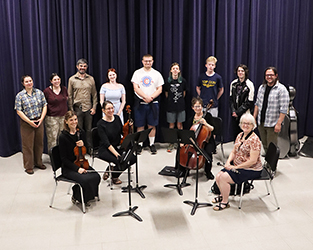
The orchestra was very ably conducted by music director Cailin Marcel Manson, with pianist James Myers and nine other musicians. The stage manager was Colin Netzley, the production design was by Calvin Meese, the circus advisor was Josh Shack and the lighting operator was Silas Gruber. Keisha Luce is the executive director of the Highland Center for the Arts.
For more information about Opera Vermont and future productions, go online to operavermont.com

David K. Rodgers
David K. Rodgers is a writer, mason and card carrying dilettante, who dabbles and babbles in art. He has lived in East Craftsbury for the past 40 years.


