
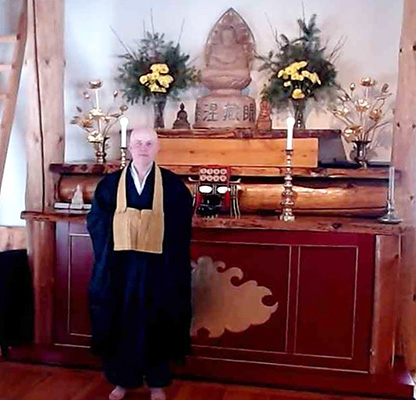

WOODBURY — Entering the Shao Shan Temple in Woodbury to speak with Reverend Kenzan Seidenberg, I felt a sense of peace that continued as we spoke about feelings related to current events.
I had come prepared to ask the Reverend, as a spiritual leader, what questions and concerns people were asking him about current events and how he was responding to them.
The Rev. Seidenberg explained that what might be helpful to one person may not be helpful to another. Right then I knew that my questions could not be easily generalized.
When people ask you how you are feeling about current world events, you may have just listened to troubling news or watched someone being disrespectful. You may quickly say you feel fearful, angry or sad. And if in the company of others who feel similarly, you may be influenced by their talk of fears, anger or sadness. It can be contagious.
What is helpful to someone is learned in a relationship, he said. That being understood, he spoke about suffering. “It is not unusual to feel helpless when witnessing the suffering of others. It affects us as part of humanity. We are not alone in feeling sadness. There has always been suffering – it is not new. It is not necessarily something to move away from, but to acknowledge that there is suffering. In others. And in ourselves.”
This type of inner awareness is learned in the practice of meditation, where a focus on breathing and present moment physical sensations can create a deeper sense of self-awareness and understanding. Developing a practice of regular meditation may take time, but you can start by slowing down, taking deep breaths, noticing your feet on the ground and trying to be present in your body.
Seidenberg explained, being in this state of presence can help bring you back to “what is it that is actually here now?” instead of getting caught in the raging “they shouldn’t be doing that horrible thing!” or the fearful “what if this leads to that horrible result?” We can actually see the blue sky and the trees and our friends, where perhaps a moment before we saw only our anger or worry.
“With this awareness, we can also recognize that there are many other people in the world right now who are probably experiencing similar feelings, perhaps fear or anger or sadness. For the same or different reasons. Maybe people on the other side politically also feel fear or anger or sadness.
“It can be reassuring to remember: ‘I am not alone. I am connected.’ How can I bring less fear, anger and sadness into the world rather than more? It may not seem like it is doing anything directly, but what if we imagine or visualize giving what feels to us to be lacking? What if we imagine giving a feeling of safety to all those who are fearful (including ourselves)? Or imagine giving a feeling of being respected and valued to all those who are angry (including ourselves)? This is akin to increasing the qualities we want to see in the world.
“What if we recognize that there is a lot we don’t know. With the news, often we are hearing one side. Can I recognize the complexity of the world and hold it openly? When we do this, we are cultivating an open mind, willing to learn from the moment, willing to not know.”
These can be steps in changing our experience: Breathe. Connect. Open.
It sounds easy but we know the news can prompt moral outrage and tangles us up when we are seeking deeper awareness. Even a single word can instigate a reaction. We can stop, breathe, shift our awareness towards qualities we want to embody. In this way we are able to give and learn from aspects of the situation we don’t know, said Seidenberg.
When asked how awareness can lead to action, he spoke about how those reflections “can lead us to take more compassionate action by helping us see more clearly what is our own reactivity and what would actually be helpful; allowing for loving, compassionate action to arise from giving up fixed ideas and opening our hearts to the joys and suffering of life.”
So, breathe. Breathe deeply, until that is what you are paying attention to. Feel your feet on the ground. Pay attention to your physical body in this present moment. From these steps of ‘breathe-connect-open’ may compassionate skillful actions arise.
Rev. Kenzan Seidenberg is Abbot-in-residence, Shao Shan Temple, Woodbury, within the Japanese school of Soto Zen Buddhism.
Eleanor Guare is a community member with experience in developing leadership and communication programs. Her work has been published by training companies worldwide.
Voices of Spirit is a regular column offering a variety of perspectives from spiritual leaders.


