
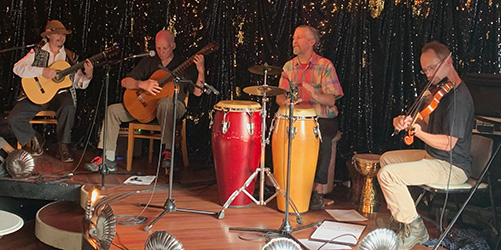

ADAMANT – The Kraatz Carromato, a Burlington quartet of four excellent musicians, came to the Adamant Community Club on Sunday evening, May 18, and gave a unique concert of Gitano-inspired music.
Gitano is one of many labels for the Roma (gypsies), both words derived from Egypt, to which people originally from Northern India migrated, as well as into the Balkans and Central Europe by the 1400s, and subsequently over all of Europe. Their language, Romani, is Indo-European, but most of their own history has been passed down orally, not in a written form.
The Roma, are the epitome of remarkable cultural survival over centuries despite horrendous persecution. They are fiercely independent and proud of their heritage, preferring the freedom of their nomadic life rather than a settled existence. They are constantly traveling in caravans (carromato means caravan in Spanish), finding temporary jobs as metal workers, picking seasonal crops, in construction, basket making, horse dealing, playing music and fortune telling. Roma music, which became popular in cafes in the Nineteenth Century, had a significant influence on expanding the rhythmic possibilities of classical music, especially for Liszt, Brahms and Dvorak. The Spanish tradition of flamenco is derived from the Roma and Django Rheinhardt, a French Roma, was one of the greatest jazz guitarists of all times.
The musicians of the Kraatz Carromato were Elijah Kraatz on guitar, flute and recorder, as well as a curious guitar with two necks but no frets, of his own invention, Harry Grabenstein on guitar, Keith Levinson on drums and Kevin Fink on violin. Together they had a highly coordinated ensemble effect and were also able to do imaginative solo improvisations.
They began with a piece that featured Kraatz playing a small wooden piccolo, which had a haunting aspect, then joined by Fink on violin and Levinson clapping the beat. The “Rose at Home” was the next selection, commencing with the guitars and then expanded to the drums and violin, all with a relaxing ambiance. The following work had a lot of feeling to it and a nice lilt to the rhythms. An old Italian anti-fascist song got the audience involved in the refrain, “Bella Chow,” with Kraatz leading the vocals.
“Funeral For My Father” was composed by Kraatz, a well developed melody suggestive of his father’s Sicilian background. Gitano elements from the Camarque region of Mediterranean France formed the basis of a pleasant tune with a nice finish on the violin. Kraatz sang in Hungarian a song about the classic search for love, with a driving beat from the percussionist Levinson.
After intermission, Kraatz played on his double neck guitar, which had a mysterious deep resonance, quite powerful, almost earthy, close to the sound of the Middle Eastern oud. He then switched to a long vertical wooden recorder which continued that mystical mood, evoking Sufi music. “Spaghetti Wedding” had singing in syllables like jazz skat, with pizzicato textures on the violin by Fink and Levinson slapping he drum heads. Another original piece by Kraatz was entitled Nameless, dedicated to the young homeless people he knew in San Francisco and Berkeley when he lived there, which had a fine melody. Again taking up his double necked guitar, Kraatz performed a work about the unnerving wind from North Africa to Spain called the sirocco, having intriguing slides that are possible on this instrument because of the lack of frets.
“After the Revolution” seemed set in Central or South America and was quite beautiful, featuring Kraatz vocalizing and Fink exploring extended improvisations on his violin. “I Was Born in Alamo” had Kraatz singing in Spanish with an expressive quiver in his voice about a longing for one’s homeland. “Gelem, Gelem” was a Roma anthem, written by a survivor of Auschwitz; an estimated 250 to 300 thousand Roma were murdered by the Nazis during World War II. The group’s last number was “While My Guitar Gently Weeps,” with creative permutations on both violin and guitar.
The world of music is endlessly rich and communicates the deepest levels of our human soul, transcending all differences of time and place and culture. It brings daily happiness and the hope that we can share beauty and live together in harmony and peace.

David K. Rodgers
David K. Rodgers is a writer, mason and card carrying dilettante, who dabbles and babbles in art. He has lived in East Craftsbury for the past 40 years.


