


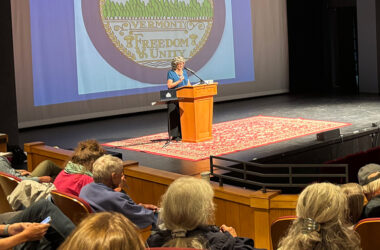


GREENSBORO – At last Wednesday’s three-hour and fifty-three minute select board meeting, the board decided to begin having two select board meetings a month beginning in September. In addition, they discussed adding a local option tax of 1% to the state’s 9% rooms tax, plus perhaps also to the 9% meals tax and the 10% tax on alcohol sales, but deferred a decision until the July meeting to give residents a chance to have a say.
Christine Armstrong said current room sales in Greensboro approach $1 million per year. The additional 1% tax would roughly raise $10k. The state would keep 25%, sending back $7,500 to the town annually.
The vote to add a second monthly select board meeting might seem to be in answer to Davis Barnett’s suggestion during the meeting’s open comment period that the board meet twice a month to get more business accomplished and perhaps shorten each meeting.
His was not, however, the first time the suggestion had been made, and the board’s suggestion after the meeting that the legal item considered in executive session had to do with the frequency of meetings, suggested it had been previously planned for consideration.
On the subject of executive sessions, the VLCT website notes, the new law now “Require[s] meeting agendas to include sufficient details on the specific business to be discussed and details on proposed executive session, if included.”
The agenda noted: “Executive Session, Personnel – Set payroll, Real Estate – Town Hall and Legal.” While the personnel and real estate agenda items included limited detail about those subjects, the legal item did not include any detail at all.
In conversation following the meeting, board members indicated the legal issue involved their decision to add the second monthly meeting beginning in September.
During open public comment, Meaghan Meachem brought up the subject of the board holding a summer meeting to discuss the town hall’s future, saying it would allow more seasonal residents to be included in the conversation.
That item came up again later in the meeting during Kent Hansen’s Greensboro Planning Commission (GPC) Update. Board member Tim Nisbet wondered if the GPC could lead discussions about the future of the town hall, but Hansen responded that the GPC is busy with other activities. Josh Karp followed up to ask whether the GPC would consider taking it on when its workload lightens up, to which Hansen said he didn’t see it as an area for the GPC to lead.
Hansen’s GPC update covered many things the committee has been working on, including completion of FEMA-required flood bylaw updates, with new flood maps. Once the process is further along the GPC will schedule a public hearing, he said. That hearing will include discussion of Shoreland Protection District bylaw updates proposed in 2024, as well as other bylaw updates required by changes to state statutes.
The GPC is also looking at amendments to the Extended Village District and Planned Unit Development bylaw sections, said Hansen.
He said the GPC plans to hire a consultant this summer to build public consensus on ways to increase the availability of housing in town using funds from a Vermont municipal planning grant.
Naomi Ranz commented that integrated mapping will be needed, as water and wastewater issues exist throughout the town. Hansen said the consultant will take all of that into the planning, and a community conversation will happen to present recommendations from the consultant and review advantages and disadvantages of the town’s zoning bylaws.
The housing subcommittee has been looking into ways to increase the inventory of both owned homes and rental homes, said Hansen. That group has suggested wastewater evaluations of the Glover gravel pit property owned by Greensboro to determine what areas may be suitable for housing. Peter Romans noted that was discussed a few years ago, and there are likely buildable lots just behind the field adjacent to Vt. Rte. 16 there.
Sheila Dillon was appointed to the planning commission following Hansen’s request that she is being recommended by the GPC. Board member Ellen Celnick suggested Dillon’s experience in Boston might not suggest she is in the best position to serve Greensboro’s needs, and others commented on her seasonal status. After Peter Romans rather heatedly commented that appointments recommended by town committees had generally been accepted previously, MacNeil quickly called for the vote.
It has been said that as much as 80% of Greensboro’s property is seasonal and, while some seasonal properties are owned by Greensboro voters, one place those seasonal property owners can have a voice in town policymaking is on the Planning Commission, which, even with Dillon’s appointment, only 40% of planning commission members are seasonal Greensboro residents.
In other business, a bid was accepted for the purchase of a John Deere loader primarily for the gravel pit at $179,644, after the $62,000 trade-in of the current loader. Town residents can each receive up to 30 yards of bank-run gravel on July 16 and 17, which they must arrange transportation for.
The grand list was finalized with no suit or appeal pending.
Toward the end of the meeting, the board was in executive session for 37 minutes, combining three agenda items in a single session. Upon its exit from the executive session, two separate motions were made and approved. One was adding the second select board meeting and before that, it was voted to approve “a pay increase of 3.5% for town office staff and the road crew, and a separate increase for milfoil staff.”
Greensboro had not posted a recording of the June 11 meeting at the time draft minutes were posted, as required by the Vermont Open Meeting Law. A Vermont League of Cities and Towns (VLCT) website page on Vermont Open Meeting Law changes effective January 1, 2002, notes they “Require the posting of meeting recordings when the minutes are posted, as opposed to when the minutes are approved.”
Minutes of the June 11 meeting were posted the evening of June 16, but a recording had not yet been posted at that time in the place where other select board meetings are posted.
In addition, no audio or video recording was made by the select board following its exit from executive session, despite an open meeting requirement to provide audio or video recordings of all select board meetings for 30 days after each meeting.
[Editor’s note: A partial recording of the June 11 select board meeting was posted to the town website, Tuesday morning, June 17. It ends at the vote to enter executive session.]
Editor’s note: an earlier version of this story incorrectly included meals and alcohol sales in Christine Armstrong’s comments about taxable sales in Greensboro approaching $1 million per year.

Paul Fixx is editor of The Hardwick Gazette and lives in Hardwick.


