
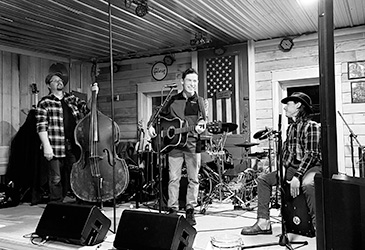



GREENSBORO – The Josiah Dyer Band came to the Highland Center for the Arts in Greensboro Friday and gave a very generous concert of some 30 songs, many of which were original works. This event was in support of a fund raised for Justice for Dogs, a local all volunteer animal rescue organization dedicated to saving the lives of local animals in need, founded in 2007 and based in Hardwick.
Josiah Dyer comes from Charleston, Maine, north of Bangor, and was accompanied by his father on bass and his brother Simeon on percussion. He began learning to play the guitar when he was 11 years old and has become an accomplished musician already at 19. What is most remarkable about him is his very distinct, beautiful voice, with fine color and warmth, excellent projection and enunciation, combined with expressive phrasing of the lyrics, truly exceptional. To all this should be added his engaging stage presence, moving his body flexibly in syncopation to the music to add visual interest to his performance and projecting a genuine personality with a sense of humor that connects with any audience. In addition to winning a number of awards in Maine, he has explored the Nashville country music scene and hopes to have a recording of his own compositions out soon.
After two introductory songs, the second about a man and a car, he sang a piece about being on a train, with appropriate rhythms of a locomotive moving down the tracks, his strong, commanding voice immediately impressive. A tune from a film called “Cold Storage” had the repeated line, “You’ve got a friend in me.” Very amusing were the lyrics to a tune about “Some of the things you should never tell your wife.” The classic oldie, “Hey, good lookin’, how about cookin’ somethin’ up with me” was given a lively interpretation. A song about a sweet old man asks the painful question, “You can’t tell me this all ends in a hearse?” had a meaningful message. Another train piece was a real toe tapper, about a long way to go and a short time to do it, east bound.
“Letters from Home” was a moving work, dedicated to veterans, visualizing how much some contact from home means to a soldier in the field. A song about “making our own way, the only way we know how,” got the audience participating saying “He Haw” at the beginning and end.
Reminiscences of dusty, dirty fields in a place where one grew up, where a young person getting no response from his father. He sees the hopelessness of any future to be had with a certain sadness, was a song with a driving beat characterized a piece about a farmer facing no rain since July and his crops dying, with the phrase “We’ll never win.” “Your Cheatin’ Heart” regretted the unfaithfulness of a lover, but felt some recompense that “the time will come when you’ll be blue.”
In reference to his family and particularly his grandparents was the song with the important exhortation to “spend time with the people you love.” Curious were the lyrics to a song saying, “that’s all right, anything you do,” including leaving the relationship altogether. Another song of parting expressed regrets but hopes that “some day your gonna ask me back.”
“Long Black Train” had that railway track clicking beat again and referred to Christ and God. A piece about a “simple man” frustrated by crime in the streets and other problems seemed to want to take the law into his own hands.
“I’m All Shook Up” was a song made popular by Elvis Presley about the physical effects of a woman. “A Better Class of Losers” was an original composition articulating a decided preference for more down to earth friends than pretentious upper class people. “Lonesome Nights” suggested that “somethings broken… that you can’t see,” and “All I can do is sit there and cry.”
“Heartbreak Hotel” was another Presley classic, and “How To Steal a Car” was a hilarious do-it-yourself manual of advice for the way someone working at a Cadillac assembly plant, with a “ten finger discount,” could steal the pieces of a car one by one over the years and then put it together at home, getting a free vehicle.
“Wondering Why” was a positive meditation of how a woman “loves me the way I am” and “Keeps on loving,” making a “little piece of heaven.” In the familiar oldie, “You Are My Sunshine,” Dyer impersonated three different singers, including Presley and Willie Nelson.
A piece about an incompatible relationship was followed by “Ring of Fire,” a metaphor for the passion of love. “Falling in Love With You” was another classic, with heartfelt lyrics.
Dyer’s last song was “I Did it My Way,” celebrating a joyful independence, “I’ve loved, I’ve laughed, I’ve cried, and now as the tears subside I find it so amazing the way I sing.” After a standing ovation and urgent calls from avid fans in the audience for one more piece, he gave an encore, singing “The Man Walked,” written this past Memorial Day, about the loss of a loved one, who will never come home again, and how “it will never be the same.”
Many of Dyer’s original songs showed a wider diversity of subjects that he explored than simply dysfunctional relationships, perhaps too typical of country western music. With his beautiful voice, charismatic personality and talent for creating fine melodies and resonating lyrics, he is definitely someone to look out for in the highly competitive world of popular music.

David K. Rodgers
David K. Rodgers is a writer, mason and card carrying dilettante, who dabbles and babbles in art. He has lived in East Craftsbury for the past 40 years.


