

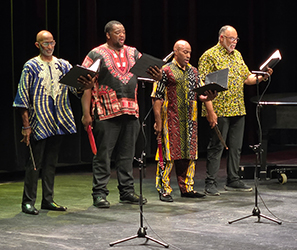
GREENSBORO – The Ellington Collective from Boston came to the United Church of Christ last week on Tuesday evening at to give a spectacular concert to a near capacity audience of some 115 jazz lovers.
The group played over a dozen pieces by Duke Ellington and his famous orchestra that had been carefully transcribed from original recordings to notated sheet music by Bob Freeman of the Berklee College of Music in order to give as authentic a sound as the studio or live performances. Freeman also adapted the tunes to be entirely instrumental arrangements.
The superbly talented musicians in the group were Professor Emeritus at the Berklee College of Music Dan Moretti and Greg Abate on saxophones, Jeff Galindo on trombone, Marty Ballou on bass, Tim Ray on piano and Marty Richards on drums, all of whom had impressive credentials from working with many well-known jazz greats.
Edward Kennedy Ellington (1899-1974) was born in Washington, D.C. and had little formal musical instruction except piano lessons, but already as a teenager he was composing and had his own five piece dance band. In 1923 he moved to New York City and expanded his musicians to 10. By 1927 he was engaged at the legendary Cotton Club in Harlem and he came under the influences of such piano icons as James P. Johnson and Fats Waller.
Ellington began recording and grew in popularity to lead one of the best big swing bands of the 1930s and ‘40s, adding another seven players to his orchestra. Billy Strayhorn (1915-67) was his chief collaborator and arranger from 1939 through the rest of his career. In all, Duke Ellington wrote some 2,000 compositions, including works for theater, film and full scale concert pieces in a more classical mode. His later concerts at Carnegie Hall in the 1940s, and his appearance at the Newport Jazz Festival in 1956, secured lasting recognition of his tremendous influence and contribution to the development of jazz in the Twentieth Century.
One fundamental aspect of Duke Ellington’s genius was in the realm of collective improvisation, namely how to keep the spontaneity and freedom of solo permutations on the initial melody that is possible in a small group but more difficult when dealing with a larger orchestra. He was “very concerned with the vital relationships between improvised solos and written out ensembles and how the two combine to form a well-balanced musical structure and a well-integrated musical whole.” (Eilean Southern, The Music of Black Americans pg. 484). He worked closely with his fellow musicians to integrate suggestions into a score with constant creative flexibility and a generous musical imagination.
The concert began with “What Am I Here For?,” recorded in 1965, a rather metaphysical question or maybe just a lover’s complaint, hard to tell without having the lyrics. It showed Duke Ellington’s skill as an orchestrator. “Jeep’s Blues” (1938) was next with an appropriately slow beat featuring the saxophone in extended improvisations. “I Let a Song Go Out of My Heart” of 1962 was a love piece with a good swing to it for dancing, a relaxed ambiance and lyrical beauty.
“Creole Love Call” (1927) was an upbeat number with a truly transporting theme, well developed with strong brasses. “Don’t Get Around Much Anymore” (1940) was a tune of regret with a classic engaging melody. “It Don’t Mean a Thing If It Ain’t Got That Swing” had irresistible toe tapping rhythms and a wonderful tune that would certainly delight any dancers.
Following intermission, The Ellington Collective played “Mr. Gentle, Mr. Cool,” a tribute to Duke Ellington by American saxophonist David “Fathead” Newman, recorded in 1994; and “Azure” was composed by the Duke in 1937 with lyrics by Irving Mills. “Cottontail” from 1940 had great momentum and improvisations that demonstrated the fine musicianship of the brass players.
“Almost Cried” was the product of Ellington’s collaboration with Billy Strayhorn, recorded in 1959. “In a Sentimental Mood” (1935) was a familiar melody that lent itself to imaginative explorations in a laid-back style. “Caravan,” written in 1936 and Juan Tizole, started with dramatic bass and then adapted rhythms that visually suggested camels moving along in an exotic setting, the very memorable tune shared among the different instruments with rich harmonic backup.
The enthusiastic audience gave the group a hearty standing ovation, which got an encore. Everyone left in an elated state, thanks to the power of music to effect us deeply and fill us with positive energy. We hope that the Ellington Collective will return soon in future Summer Music from Greensboro programs.

David K. Rodgers
David K. Rodgers is a writer, mason and card carrying dilettante, who dabbles and babbles in art. He has lived in East Craftsbury for the past 40 years.


