
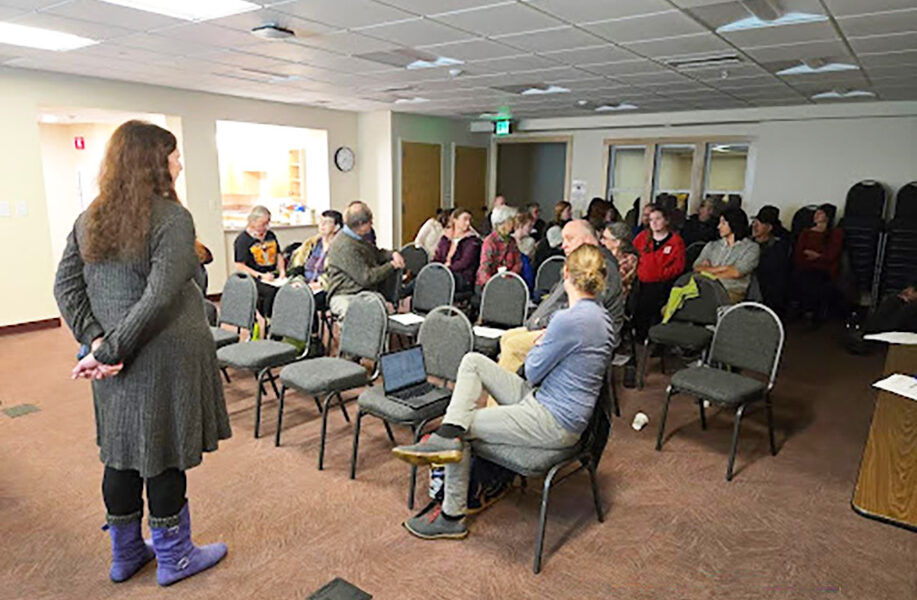




HARDWICK – Area school board members and legislators were well-representated at a forum led by members of the three Hardwick school boards that was billed as a community conversation about Vermont’s Act 73 school redistricting legislation, last Wednesday in the Jeudevine Memorial Library.
Board members shared what they know about the Act 73 process, its possible effects in Hardwick. They hoped to elicit information, comments and questions from the audience and legislators to help in their work surrounding the issue.
It was clear there are a lot of questions left to be answered as the process moves forward, even for Caledonia County Sen. Scott Beck, an insider to the process. Senate Minority Leader Beck is a St. Johnsbury Academy social studies teacher and a representative to the Vermont Act 73 Redistricting Task Force.
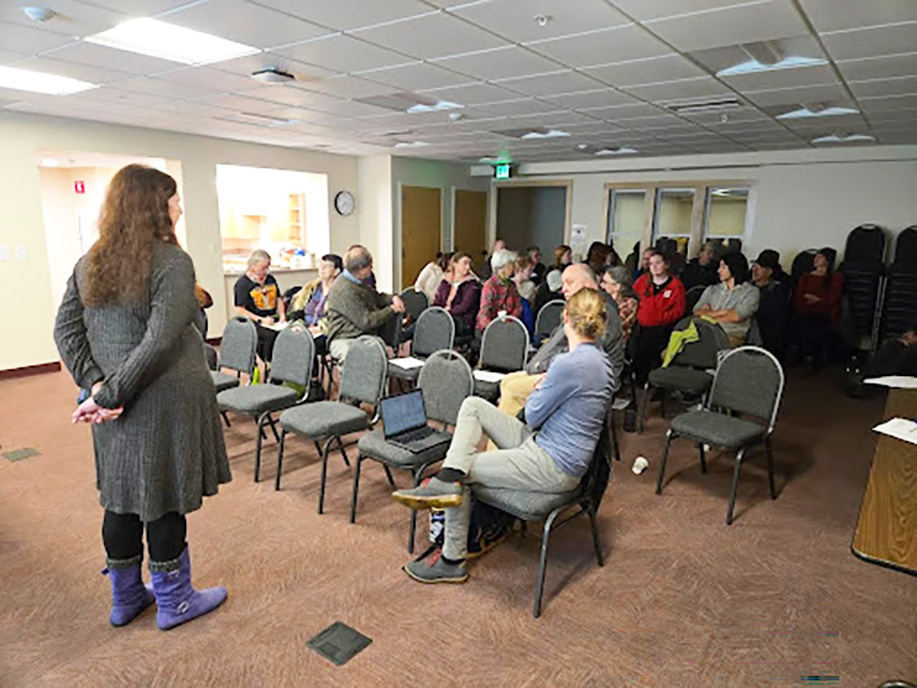
photo by Paul Fixx
That task force is charged with providing three maps on December 1 with potential new Vermont school districts for the legislature to consider when it returns in January.
Beck had been with the task force at its meeting in Winooski the day before and was able to share some of the current thinking of that group as it works to develop the maps.
Ranny Bledsoe, who serves on both the Hazen Union School Board (HUSB) and the Orleans Southwest Supervisory Union Board (OSSU), began the evening with a presentation for the roughly 30 attendees in the room and a handful online.
She said there are few answers to the many questions raised by Act 73, but the school boards are working to educate the public and gather input based on what information is now available.
She made it clear that Vermont’s education system is creating effective student outcomes, with Vermont measuring well against other states.
She summarized challenges of rising education costs that she said are due in part to a statewide decline of roughly 20,000 school-age students over the last 20 years. When the cost of facilities designed for more students is combined with inflationary pressures, competitive wages, legislative mandates and a shift to delivering services in schools that were once available elsewhere, such as those for mental and physical health, taxes continue to rise.
Provisions of Act 73 include district consolidation, moving toward fewer school districts by July 1, 2028; a foundation formula to replace the current education funding system for the 2028-2029 school year; a statewide property tax to replace the current system that varies by district; a new income-based homestead property tax exemption and class size minimums to be implemented in July 2026.
Beck later explained the funding formula begins with a set amount per student to equal the state’s current total education expense, then makes adjustments, though the details are yet to be determined.
The current funding figure would be just over $15,000 per student, he said.
Suggested adjustments to the base per-student funding amount would be made for economically disadvantaged students, English language learners, special education students, career and technical education (CTE) students, preschool students and some district-level adjustments for school scale and district sparsity.
Kyle Anderson, Hardwick’s representative to the Mountainview Union Elementary School District (MVUESD), helped answer questions and gathered details about class size minimums in response to questions about the item that seemed to be a concern for many in the room. The proposed class size minimums exempt pre-K and K classrooms, then set a 10 student minimum for grade 1, 12 students for grades 2 to 5, 15 for grades 6 to 8, and 18 for Grades 9 to 12, he said. The State Board of Education will be able to grant waivers in some cases, for geographic isolation, as an example.
Beck said there will likely be adjustments for Advanced Placement (AP ) classes, CTE students and the need for special materials, and that he sees the class size minimums as the “most unfortunate part of the bill.”
Moving on to statewide redistricting maps, Bledsoe explained three maps have been looked at by the task force so far. One is based on county boundaries, one on CTE centers and one, called the Board of Cooperative Educational Service (BOCES) model, is designed around resource sharing between supervisory unions.
Bledsoe then explained that the new funding formula and the tax adjustments associated with it will be repealed if the legislature does not approve a new map of state education districts during the upcoming 2026 session that begins in January, as will a new second home tax.
Minimum class size requirements and a reduction in the number of private schools qualified to receive private funds will still become effective in the absence of a new map, she said.
If a new map is approved, the new school districts would become effective July 1, 2028, with the foundation funding formulae and a uniform statewide education property tax rate will take effect for the 2028/9 school year.
Even with new administrative districts, schools will remain as they are for now, said Bledsoe, but it’s expected the new “districts will have to begin to consider school closures and mergers.”
She said there is no information available now about how these changes will affect taxes. “A major argument for redistricting is the possibility of lower taxes, but there is no way of knowing at this point.”
Questions remain about school infrastructure where there are significant issues with deferred maintenance, said Bledsoe. “It is not clear how new districts and reconfigured schools will address this.”
In the audience were Rep. Michael Southworth, who now holds that Caledonia-2 seat; Rep. Leanne Harple, a language arts teacher at Hazen Union School, who lives in Glover, representing Orleans-4 in the House, where she sits on the Committee on Education; Sabrina Morrison, who serves on both the HUSB and OSSU boards and Woodbury’s Steven Freihfner, HUSB Chair.
Terri Vest, who serves on all three Hardwick school boards: MVUESD, HUSB and OSSU, moderated a lively and civil discussion following Bledsoe’s presentation.
Orise Ainsworth said the “goal [of Act 73] is closing small schools as I see it.”
Morrison said the savings are unknown. It “seems foolish to go through this without more certainty,” and health care seems one of the biggest issues that isn’t addressed at all by Act 73.
Beck said “redistricting is not an exercise in saving money, it’s an attempt to move to a more efficient system.”
Responding to a question from Hardwick resident Rachel Cole about what makes it inefficient, Beck said the current system is top-heavy with superintendents.
Cole asked how student outcomes fit in. Erica Sisk echoed that concern, wondering what KPIs (key performance indicators) will be measured.
Many returned to the question of health care costs and the apparent lack of attention to those costs under At 73.
A comment was made about the broader context of how we encourage people to move to Vermont where there are few jobs in an environment where there’s a threat of local schools closing.
Woodbury’s Cindy Gorden wondered about what she said are 1,300 school board members in Vermont and fewer in larger states.
In response to a question about student involvement in the Act 73 process from Sadie Gann, Hazen Union School’s Student Council President, Rep. Harple said she’s been working with the Vermont Youth Student Council on a proposal to establish students as voting members of school boards.
Hardwick Elementary School art teacher Beth LeCours said taxes are going up, health care costs are going up and an issue is how far students are traveling. She said all of this misses the important questions which should be asked of teaching professionals: “What do you need for the students?” She said, “I want the money spent on kids. Being rural is real, a district of 4,000 students is unrealistic in the Northeast Kingdom (NEK).”
“The VPA (Vermont Principals Association) and superintendents are people who work to keep their jobs,” said LeCours.
Gordon said “communities are the foundational unit in the state” and closing schools will have a negative impact on that, with redistricting leading to a suburbanizing rural Vermont.
Cole talked about her experience in Iowa where redistricting led to small town schools disappearing, towns being hollowed out and students having to travel a long way to school. She said “Vermont is very special,” where she has been surprised driving through town after thriving town.
Audrey Grant commented on closing schools and losing towns, suggesting “Hazen doesn’t seem safe from closure.” She said she’s frustrated with the process and thinks Act 73 misses opportunities to move away from a property tax model to pay for schools, failing to take into account reports by the Public Assets Institute on alternative school funding models.
Morrison said smaller schools in Vermont give students opportunities and offer equality that larger athletic programs can’t as they need to cut students. Gann and another commenter agreed, adding long drive times is likely to create less equity.
Beck said there’s been lots of research on drive times and bus times and what it means.
Vest added that 50% of her 11th graders have full-time jobs and would likely be impacted if they had to travel long distances to school, making them less available for local work.
She wrapped up the conversation noting the evening was “an awareness session with not very many answers,” expressing concern that quality education is not part of the conversation and her students deserve quality educational opportunities.
Board members are asking Hardwick residents to share their concerns and interest in staying informed about the redistricting process by filling out a survey at bit.ly/survey-school-redistricting-hardwick

Paul Fixx is editor of The Hardwick Gazette and lives in Hardwick.


