

GREENSBORO – Concerns about plans by the Greensboro Conservation Commission (GCC) to eradicate Japanese knotweed at two pilot project plots have generated a flurry of messages between residents concerned about how the process may affect pollinators and the GCC’s Will Marlier, who takes the lead on invasive species eradication for the GCC.
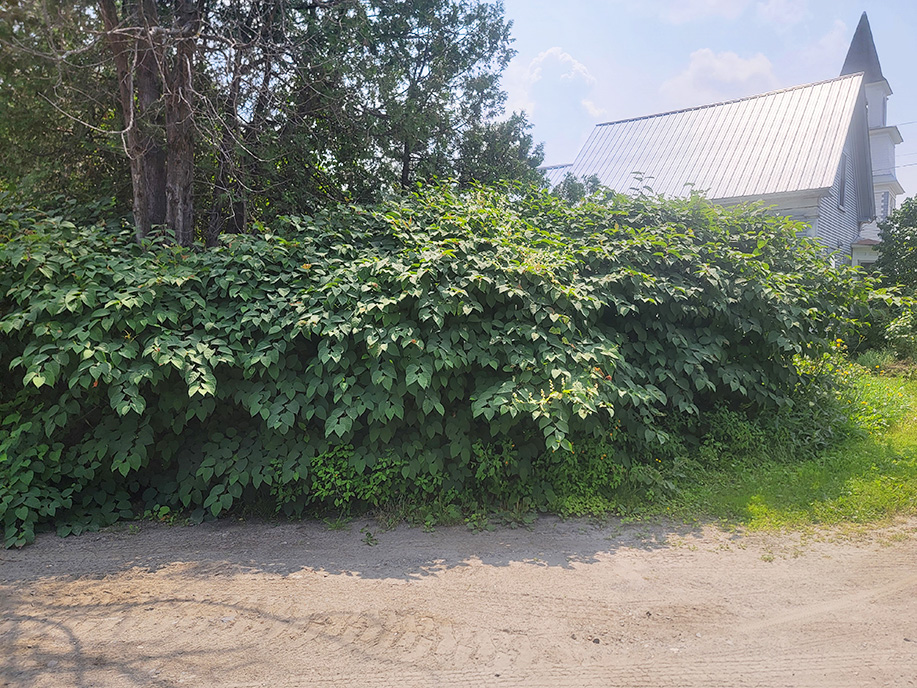
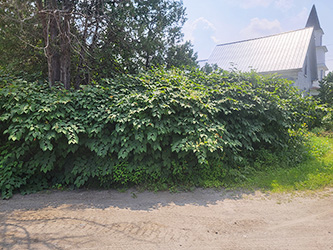
photo by Will Marlier
The GCC voted to employ a stem-injection process using the chemical glyphosate to eradicate monocultural growths of knotweed for pilot projects at Highland Lodge and Smith’s Store.
Zoryan Ivakhiv-Gray wrote a letter to the GCC, November 17, expressing concern over the use of chemical herbicides to which Marlier responded in a way that suggested Ivakhiv’s concerns had been in error.
Further messages seem to have clarified an ambiguity in Ivakhiv-Gray’s letter to the commission, though continued debate continues about whether glyphosate and products containing it, such as RoundUp, are potentially dangerous.
Ivakhiv-Gray had written that “RoundUp and certain other chemicals used as fall stem-injection herbicides on knotweed have been [known to] contain chemicals Glyphosate and PFAS (Per & Polyfluoroalkyl Substances), which are systemic forever chemicals, that can stay in their environment and water cycle for many years, and are easily absorbed by plant life and dispersed by water, even small quantities.”
Marlier’s November 18 response said “It is important to note that glyphosate is not a PFAS or forever-chemical”
Ivakhiv-Gray’s response acknowledged the distinction between products containing glyphosate and those containing PFAS, saying, “When I wrote that ‘RoundUp and certain other chemicals [used similarly] as fall stem injection herbicides on knotweed contain glyphosate and PFAS,’ I meant that some knotweed herbicides contain glyphosate (RoundUp does), and others contain PFAS, since I had no idea which herbicides the commission was considering.
With that issue seemingly cleared up, Marlier’s initial response continued on to address the issue of whether glyphosate is a carcinogen. “As for the claim that glyphosate causes cancer, there is overwhelming evidence that that is not the case.” He continued, citing information about various studies and organizations that come down on the side of glyphosate being safe when used correctly and pointing to the purpose of working to eradicate invasive knotweed.
Ivakhiv-Gray responded suggesting there’s at least more nuance in the dangers of using glyphosate, “Whether RoundUp is carcinogenic is a complex topic, as my understanding is that Bayer and certain groups maintain that it isn’t at all, while others suggest it may be a very minor risk (as you mentioned), or possibly even a major risk, given the connection with non-Hodgkin’s lymphoma (according to the book “Toxic Legacy” by Stephanie Seneff).
Marlier points to in-depth studies and the GCC having looked at sites using chemical control of knotweed as evidence for its limited use at the two pilot plots. He said it’s used by the Nature Conservancy, Northwoods Stewardship Center and the Vermont Transportation Department (VTrans), organizations known to be concerned about introducing dangerous materials into the Vermont ecosystem.
Concerns about the GCC’s use of herbicides being in potential conflict with the Greensboro Pollinator Protection Policy (PPP) come down to nuances of a topic that gets more complicated the deeper one looks into it.
Most basically, the PPP references only insecticides. Both insecticides and herbicides are pesticides, but herbicides are not insecticides. Pesticides include herbicides, fungicides and rodenticides, as well as insecticides and herbicides.
Ivakhiv-Gray’s group, that was instrumental in bringing the PPP resolution to Greensboro’s Town Meeting for consideration when it was approved last year, is now discussing a possible revision that would ask townsfolk to reduce all pesticide use.
Mike Bald, who has been working in organic weed control for many years, having continuously monitored knotweed plots for up to 14 years, said, “Anyone who has done knotweed management knows it is a multi-year endeavor, even with chem[ical] usage, most professionals will admit a minimum of five years is necessary. The repeated use of herbicides in the same location year after year is likely more problematic than the initial single application.”
Marlier says the GCC is concerned that invasives have taken hold at properties around Greensboro in such abundance that it will be impossible for the GCC to control them completely given the constraints of time, money and a volunteer organization. Local control, if not complete eradication, will depend on landowners identifying invasives and taking measures to control them when found, he said.
Discussing the Greensboro brochure about invasives, Marlier said the recommendation for controlling knotweed with mechanical means is because there are significant upland and riparian areas in Greensboro, where any chemical form of knotweed control is not advisable. The nuances of identifying those areas informed creation of the brochure so as not to suggest methods of control that would be inappropriate in any circumstance a landowner might have difficulty identifying.
Marlier says he’s available to help when landowners want confirmation that they have invasive species growing and he will make visits, and recommend treatment options.
Bald suggested great care is necessary and informs his organic practices, concluding his comments with, “”Even birds know better than to soil the nest.”

Paul Fixx is editor of The Hardwick Gazette and lives in Hardwick.


