
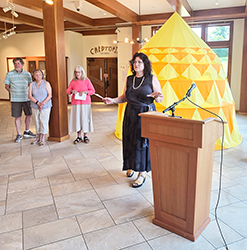

GREENSBORO – Alisa Dworsky talked extensively about the design and fabrication elements of the “Phase Change I,” installation during the opening reception for her Phase Change show at Highland Center for the Arts in Greensboro, Sunday June 28.
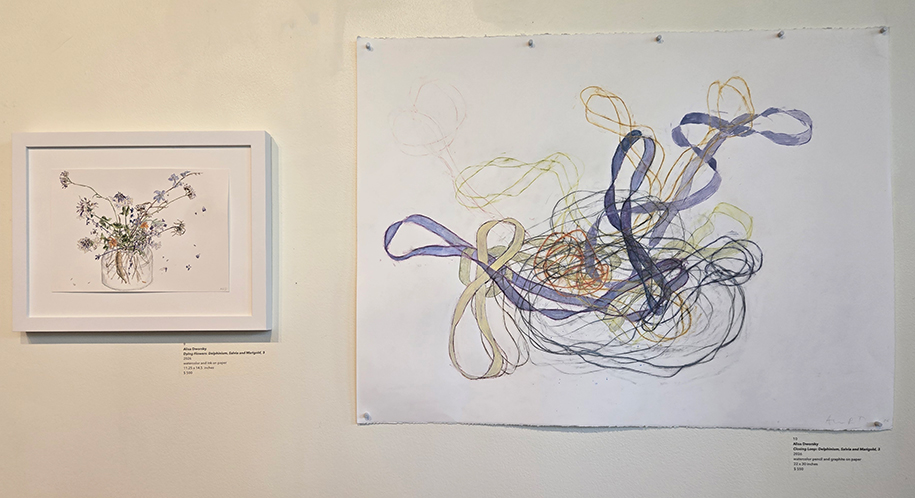
Alisa Dworsky’s “Phase Change” exhibit at Highland Center for the Arts through July 26, explores impermanence through the passage of time. Her drawing (right) “Closing Loop: Delphinium, Salvia and Marigold, 3,” abstracts the exploration of what happens as water evaporates from a vase of flowers to its left in “Dying Flowers: Delphinium, Salvia and Marigold, 3.”
“Phase Change brings together works on paper and a large-scale installation that explore impermanence through the passage of time,” notes the exhibit’s artist statement.
“Using ink, watercolor, graphite, fabric, glass and water, “Dworsky examines how evaporation reshapes matter while revealing unexpected complexity. These works reflect on the beauty that endures with age, the effects of diminishing water on living structures, the desire to preserve something of the garden, and the failure to hold a moment of bloom.”
The Dying Flowers series of watercolor and ink works on paper looks at the process of change in bouquets as their water source evaporates.
Each Dying Flower drawing is accompanied by a drawing in Dworsky’s Closed Loop series made with watercolor pencil and graphite, abstracting the form and colors of the Dying Flower drawings they accompany.
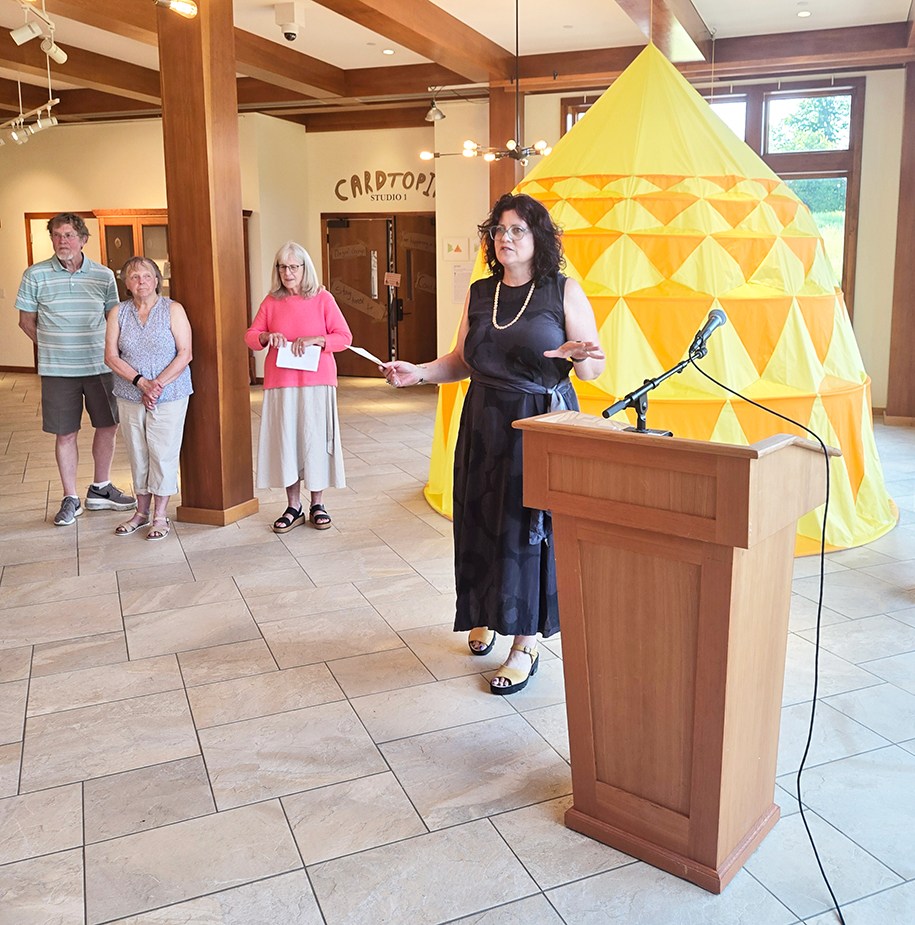
photo by Paul Fixx
“Together, the two bodies of work demonstrate how representational and abstract visual languages can emerge from a shared source, each offering a distinct way of perceiving the rhythms and patterns embedded in natural phenomena,” says the artist’s statement.
The ten-foot-high suspended fabric installation, titled Phase Change 1, is constructed from orange and yellow ripstop nylon. Counterbalanced by a vessel of water, the expansive conical structure is now upright as the exhibition opens. As the water evaporates, the equilibrium of weight will shift and the structure will slowly collapse.
The work is intended to make the passage of time tangible, making visible the physical consequences of water loss while echoing the processes depicted in the drawings. Like the flowers, the work exists within a cycle of growth, transformation and dissolution.
It will be interesting to return to the gallery as the month passes to watch the installation’s process sinking onto the floor during the exhibition running through July 26.

Paul Fixx is editor of The Hardwick Gazette and lives in Hardwick.

