


by Susan Shea
RANDOLPH – When our lilacs bloom in late May, pale yellow butterflies with black stripes arrive to feed on their nectar. These are tiger swallowtails. These exquisite butterflies have a broad black band along the edge of their forewings bordered with yellow dots. They also have small red spots and “tails” at the base of their hindwings. Both the Canadian tiger swallowtail and the eastern tiger swallowtail inhabit our region, and are easy to spot, although the two species can be difficult to distinguish from one another.
“One of the most magnificent butterflies of spring, showy in flight and unmistakable in its markings, is also a magnificent source of mistaken identity,” Vermont-based field entomologist Bryan Pfeiffer wrote about tiger swallowtails in an article on his website.
Eastern tiger swallowtails (Papilio glaucus) are larger and deeper yellow than Canadian tiger swallowtails (Papilio canadensis), with a thinner black line along the margins of the underside of each hindwing. Identification can be challenging, in part, because the two species hybridize. To make things more confusing, some female eastern swallowtails look like a different species altogether. They are black with a bluish cast, although the row of yellow dots on the outer edge of the forewing is a clue to their true identity.
Smaller, lighter-colored Canadian tiger swallowtails are the most common of these species in northern New England. Found in deciduous and mixed forests, pine barrens, and along woodland edges and stream banks, they have also adapted to meadows and gardens. From late May to mid-July, these butterflies emerge from the chrysalises where they spent the winter. (If you see a tiger swallowtail after July, it is likely an eastern, which has two broods per year and flies through September.) In some years, tiger swallowtails are quite abundant – I’ve had to watch carefully to avoid hitting these butterflies while driving down our dirt road. They spend their brief lives (one to two weeks) mostly feeding, resting, and reproducing.
Like many other butterflies, tiger swallowtails visit flowers to partake of the sweet nectar, often pollinating these plants in the process. To harvest nectar, a butterfly unfurls its proboscis, a tube that functions like a straw and is coiled below the head when not in use. It inserts the proboscis into the flower and sucks up nectar by rhythmically contracting the muscles in its head. Sugars in the nectar provide energy for flight, defense, reproduction, and other daily activities.
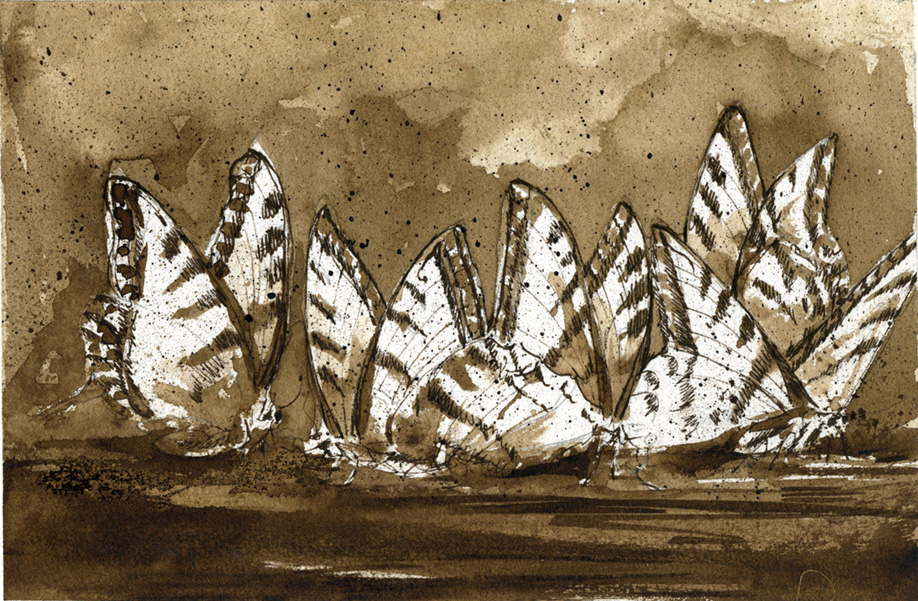
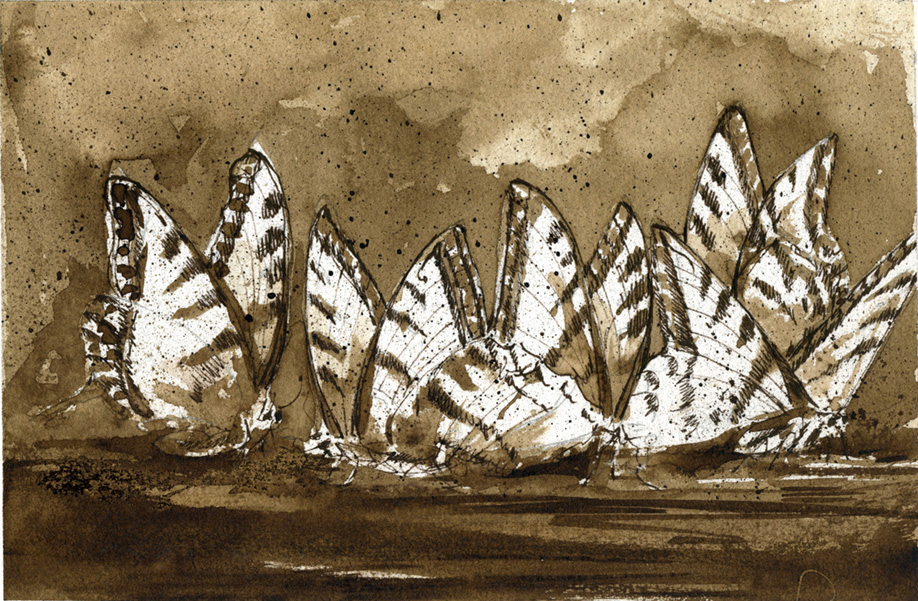
Tiger swallowtails also obtain nutrients and replenish fluids through “puddling,” congregating in large groups on mud or wet sand around puddles, on stream banks, and on piles of fresh manure. Here they take up salts, proteins, and minerals with their proboscises. Salt is scarce in the butterfly diet, but is essential for reproduction and flight. Puddling is primarily a male behavior, and during mating, a male butterfly transfers salt to a female in a sperm package, which she incorporates into her eggs. Researchers have found that sodium increases reproductive success in some butterfly species. During puddling, groups of males are conspicuous to females seeking mates. Males also patrol at treetop level looking for mates, swooping down to intercept females.
The female Canadian tiger swallowtail lays her eggs singly on the leaves of aspen, birch, willow and black cherry trees. Eastern tiger swallowtails prefer tulip, black cherry, and sweet bay magnolia trees. Caterpillars hatch in about a week. The residual egg yolk provides their first meal. Brown and white, at first the caterpillars resemble bird droppings – a defense tactic to diminish the chances of being gobbled up by a hungry predator. They spin a silken mat in a curled leaf to rest on and feed from. As they grow larger, the caterpillars molt their skin several times, going through five stages or “instars.” In the final instar, a swallowtail caterpillar is dark green with two false eyespots and a yellow collar. Finally the caterpillar turns brown and attaches to the underside of a stick or dead leaves on the ground. The skin splits to reveal a chrysalis. Here, the caterpillar will overwinter until emerging as a butterfly the following spring.
As with other butterfly species, tiger swallowtails can be affected by loss of habitat, pesticide use, and climate change. To help butterflies and enjoy their beauty, plant native flowers, trees, and shrubs, and leave a portion of your lawn unmown to create meadow habitat. Adult tiger swallowtails are especially attracted to the blossoms of cherry, lilac, blackberry, raspberry, clovers, joe-pyeweed, milkweed, and thistle.
[Susan Shea is a naturalist, writer, and conservationist based in Vermont. Illustration by Adelaide Murphy Tyrol.]


