
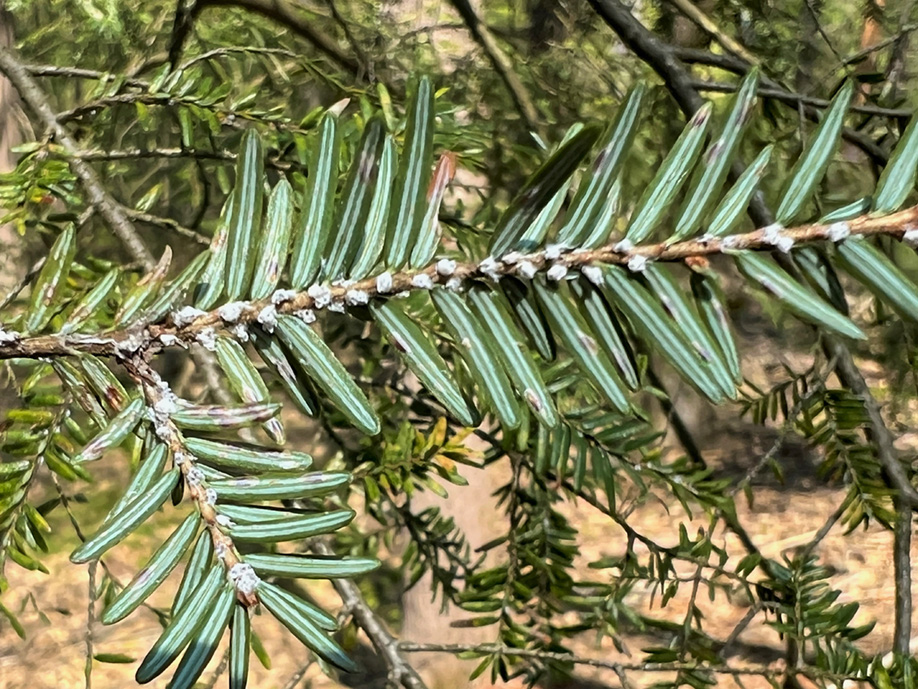


photo by Ali Kosiba
The appearance of cottony or woolly masses on the underside of the foliage at the base of a hemlock’s needles indicates the presence of the hemlock woolly adelgid, an invasive forest pest.
BURLINGTON — The eastern hemlock (Tsuga canadensis) is a keystone tree species in northern forests with ecological, economic and cultural significance.
Hemlock stands provide both important wildlife habitat, including shade to cool trout streams, as well as a place for camping, hiking, hunting and other recreational activities. In addition, this softwood species, while lower in sawtimber value than many other species, is harvested commercially for pulpwood, bark mulch and construction and landscape timber.
However, hemlock is vulnerable to a number of threats to its survival, among them the impact of climate change and the spread of invasive species, including the hemlock woolly adelgid (HWA) and elongate hemlock scale (EHS). Hemlocks are considered a foundational species, helping to create favorable conditions for other plants and animals, so any decline or loss in hemlock will have a ripple effect.
To help landowners, forest managers and foresters conserve and protect the eastern hemlock, the Vermont Department of Forests, Parks and Recreation; University of Vermont Extension; Vermont Department of Fish and Wildlife and the Atowi project collaborated on developing the Management Guide for Eastern Hemlock Conservation in Vermont. This recently released guide offers comprehensive and sustainable strategies for maintaining hemlock stands in Vermont’s forests.
The guide covers the biology and importance of hemlock; identification of potential threats, including native and non-native insect and fungal stressors; and the long-range impact of hemlock decline and mortality. It also describes the state’s efforts to monitor public lands for HWA and EHS infestations and how the public can scout for these invasive pests on private land.
Other sections deal with management and controls, which range from taking an Integrated Pest Management (IPM) approach to the use of biological or chemical controls, cultural methods and active and passive silvicultural techniques. The guide also includes information on the Vermont Department of Forests, Parks and Recreation’s work to preserve hemlock genetic material and U. S. Department of Agriculture programs and funding opportunities for the management and treatment of hemlock on private lands.
To view the guide, go to go.uvm.edu/hemlock.


