




courtesy photo
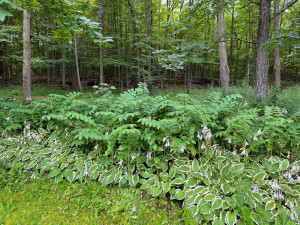
A New England native, Solomon’s seal is an ideal choice for a woodland garden as it pairs well with many other perennials, including hostas, throughout the growing season.
by Nadie VanZandt, Extension Master Gardener, University of Vermont
PANTON – If you want to add a touch of architectural interest to your shade garden, look no further than the graceful silhouette of Solomon’s seal.
Solomon’s seal is a hardy herbaceous perennial for shade that spreads through rhizomes to form clumps of tall arching stems covered with attractive green foliage. Its name refers to the circular scars left by its stems on the rhizomes after die-back. According to folklore, the biblical King Solomon placed his seal upon this plant when he recognized its great medicinal value.
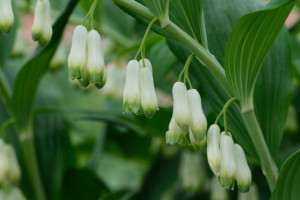
In spring, it bears discrete tubular white flowers that dangle elegantly below the leaves, accentuating the curve of its tall stems. From spring to summer, Solomon’s seal imparts an attractive backdrop to the shade garden with its foliage fading to a gentle yellow in autumn.
Solomon’s seal is the common name for approximately 60 identified species of the genus Polygonatum, a member of the lily family (Liliaceae), including Polygonatum biflorum, a species native to eastern and central North America. In Latin, Polygonatum means “many knees,” referring to the plant’s fleshy, jointed rhizomes.
courtesy photo
In spring, Solomon’s seal has tubular white flowers that dangle from the undersides of its attractive green foliage, adding a touch of elegance to the plant.
A New England native, Polygonatum biflorum, grows to three- to five-feet in height and spreads one to two feet wide. It’s also known as Smooth Solomon’s seal, King Solomon’s seal and Great Solomon’s seal.
The woodland is its natural habitat. For this reason, it thrives in shade or part-shade, favoring dappled morning light over afternoon sun. Although it prefers a moist well-drained soil rich in organic matter, it is not fussy. It also does well in challenging, dry-shade spots near tree roots.
In addition, its sturdy stems do not require staking. Fallen leaves provide an ideal mulch and compost material for the plant.
This rhizomatous perennial is a low-maintenance, slow-growing plant that can live for decades without requiring much care. Planted in the right location, Solomon’s seal will form colonies to grace your landscape with its distinctive profile.
This perennial prefers to grow in consistent, but not overly wet, moisture. Yet, once established, it tolerates drought. It also is disease-resistant and unappealing to deer, both attractive characteristics.
After flowering in summer, the plant develops small bluish-black berries. These berries are very much appreciated by birds though slightly toxic to humans. Young shoots and rhizomes are edible when cooked and served like asparagus and potato, respectively. Historically, the Native Americans and colonists ate its starchy roots.
Solomon’s seal is easily propagated by division when the plant is dormant in spring or fall. Starting with a well-established clump, use a clean, sharp knife to cut a rhizome into several sections, making sure that each section has a bud.
Place the sections horizontally in the soil, buds up, 18 inches apart and one inch deep. Water generously, taking care to keep the area cool while the new plants grow.
This graceful plant is a great choice for a woodland garden and pairs well with many other perennials throughout the growing season. Companion plants include hosta, hellebore, narcissus, tiarella, epimedium, brunnera, aquilegia and ferns, among others. They are also stunning at the base of trees and shrubs.
With such attractive features, Solomon’s seal is a must-have for your shade or woodland garden. What’s more, you can jazz up your cut-flower bouquets with its beautiful arching stems.
[Nadie VanZandt is a UVM Extension Master Gardener from Panton.]


