



by Susan Shea
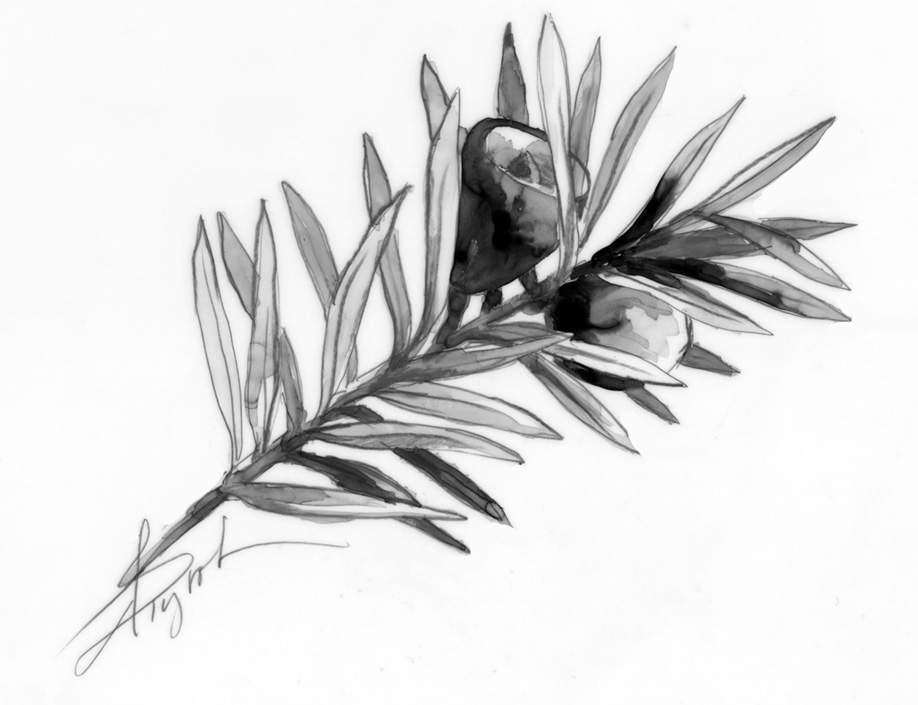
BROOKFIELD – For thousands of years, people have decorated their homes with evergreen boughs, a symbol of eternal life, during the darkest time of the year around the winter solstice and Christmas. In addition to common species such as spruce and fir, I’ve noticed another evergreen in my neighborhood: a low, sprawling shrub growing on the slope of the ravine above a stream. This evergreen is located in a cool, shady spot under hemlocks, where the snow and ice always melt last in springtime. The shrub’s flat, dark green needles are ½ to 1 inch long, with sharply pointed tips and two faint while lines on the underside. This is Canada yew (Taxus canadensis), also called American yew.
Canada yews can easily be mistaken for small balsam fir trees that have been browsed by deer. The needles of balsam fir, however have rounded tips and strong white lines underneath. In contrast to fir, the bases of yew needles run down the stem. Yew branches often trail 6 to 8 feet along the ground, and upright branches are usually less than three feet tall. The bark is thin and reddish.
This native yew occurs from southeastern Canada, throughout the Northeast, and as far south as North Carolina and Tennessee, where it grows in the mountains. Canada yew grows in coniferous, northern hardwood, and mixed forests, and occasionally in bogs or swamps. An understory shrub of old-growth and late successional forests, it is tolerant of deep shade and typically grows on cool, moist banks beneath larger conifers. Yew is often found near other understory trees and shrubs such as mountain maple, striped maple, hobblebush, and alternate-leaved dogwood. Where it is abundant, yew forms a dense ground cover. As mature forests with good habitat for yew have become limited, the plant has become less common. Logging, fire, or heavy browsing can eliminate yew from an area.
In spring, tiny cone-like flowers develop, with male and female flowers on different branches of the same plant. Pollen from the male flowers travels by the wind onto female flowers, both on the same shrub and different shrubs. After fertilization, each female flower develops a single seed surrounded by a soft, red covering, called an aril, which is open at one end. Yew is the only conifer to produce seeds with a fleshy structure, rather than a hard cone. Canada yew may also reproduce asexually by layering, whereby creeping stems develop roots while still attached to the parent plant. Eventually the connections between plant sections rot, creating spreading clones.
In late summer and fall, ruffed grouse, cedar waxwings, robins, and other birds consume the arils and subsequently disperse the seeds in their droppings. Moose and deer eat the foliage of Canada yew year-round. In places undisturbed by these browsers, such as some islands in the Great Lakes, yew may grow as tall as 10 feet.
All parts of the yew except the fruit pulp are mildly toxic to humans. However, traditional uses include brewing yew needles into a tea for treating rheumatism, fever, colds, and other ailments. In recent decades, scientists have found that Canada yew is a good source of the cancer-fighting chemical paclitaxel, originally discovered in the Pacific yew. It also contains two other taxanes that can be used to synthesize paclitaxel. In eastern Canada, farmers grow yew in plantations for use in cancer treatments. Sustainable harvesting from the wild according to regulations is also permitted there.
In the Northeast, Canada yew is relatively scarce, and so is not a good choice for holiday decorating. But its evergreen foliage and red, berry-like fruits are something to admire on woodland walks.
[Susan Shea is a naturalist, writer, and conservationist based in Vermont. Illustration by Adelaide Murphy Tyrol.]


