
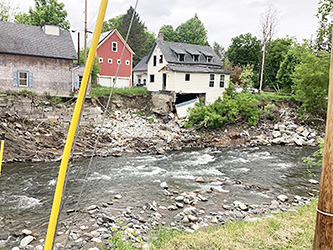


HARDWICK – If you walk down Brush Street and look toward the river, it is still easy to picture the home that once stood at 41 Brush Street. In early 2023, a fire destroyed the house and the owner lost their life in that fire. Six months later, the July flood arrived before plans or decisions could be made by the family. The river cut away the bank, leaving the remains of the house hanging over the riverbank, damaged and unsafe.
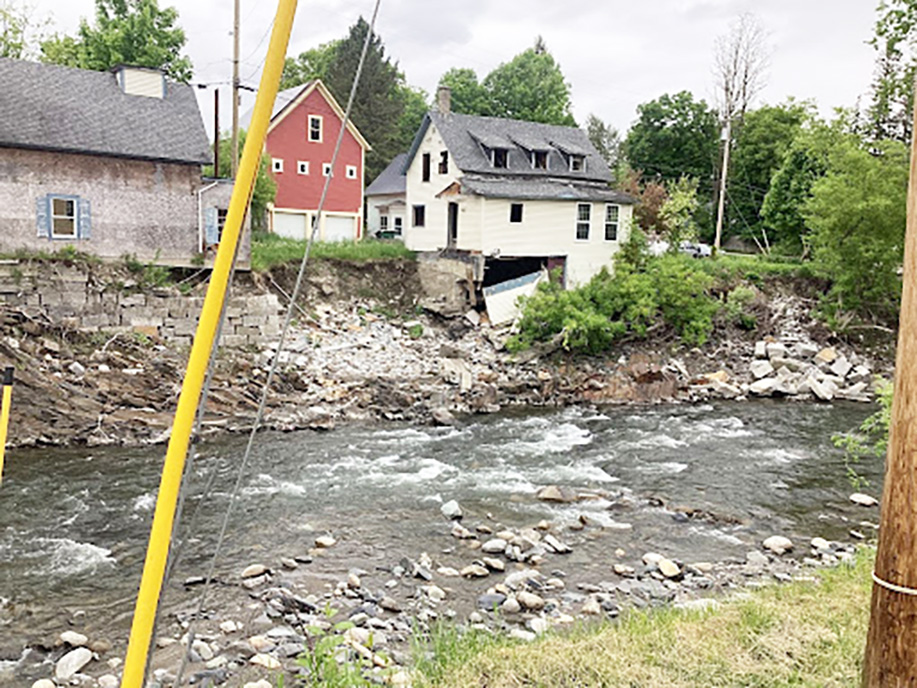
photo by Kristen Leahy
Town staff began working with the estate soon after the flood to evaluate stabilization options. We had recently supported three other Hardwick homeowners with similar erosion issues, so the initial steps were familiar.
As engineers began their review, it became clear the accessory building on the property was compromised too. What began as a repair discussion quickly became a conversation about long-term safety and responsibility for a property that could not be left as it was.
The estate chose to enter the federal property buyout program, transferring ownership to the Town of Hardwick with the land to remain as permanently protected open space.
That decision ensured the damaged structures could be removed and the land secured, rather than slowly collapsing into the river. It also meant the estate did not shoulder the burden alone. More flooding followed in December 2023, then again in July and August 2024, each storm adding new erosion and urgency.
This project uses two federal programs that operate in sequence: the Hazard Mitigation Program from the Federal Emergency Management Administration (FEMA) for demolition and acquisition, and the Emergency Watershed Protection program from the Natural Resources Conservation Service (NRCS) for riverbank stabilization. Because the programs cannot overlap, demolition had to occur first.
The State of Vermont contracted with ReArch Company to handle demolitions statewide, and once the Brush Street property closed, it became one of the earliest FEMA buyout demolitions to move forward in Vermont.
NRCS had initially planned to complete the riverbank stabilization design internally, but federal staffing changes shifted that work to the town. NRCS provided funding and Verdantas Engineering was hired by the town to complete the design once demolition was finished.
Demolition is now complete, and engineering is underway.
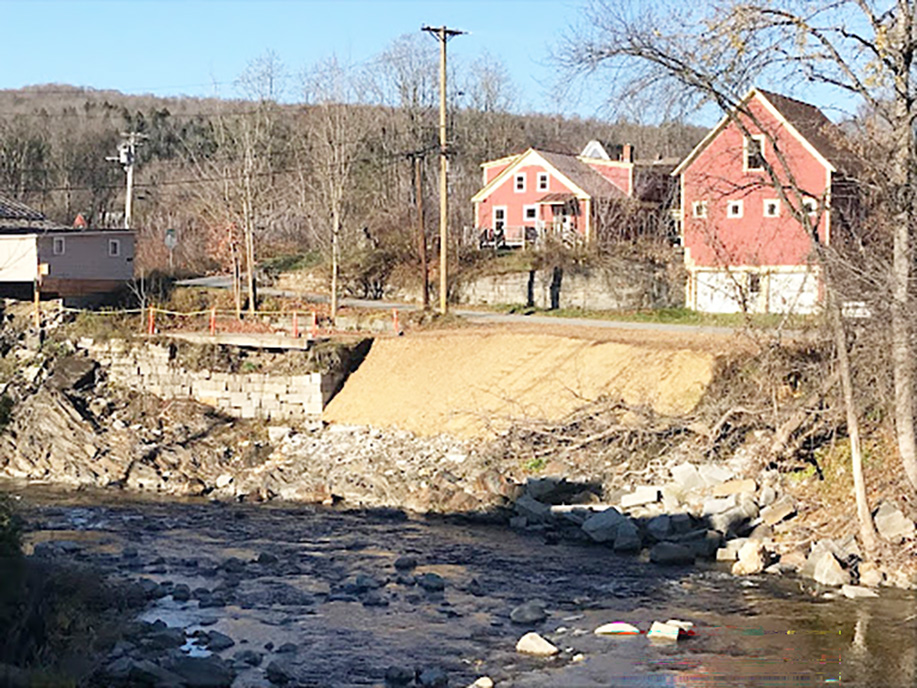
photo by Kristen Leahy
Stabilization construction is scheduled for spring 2026. The work will protect nearby infrastructure, including the roadway, water lines and remaining Brush Street properties.
Some features will remain in place. The concrete slab from the former accessory building must stay for structural reasons, although it is not suitable for public use.
Over time, small touches such as planters may be added to soften the space while maintaining safety.
An historic stone retaining wall along the river will also stay. A photograph located in the Hardwick Historical Society archives shows that wall already in place in 1927, holding the bank through decades of high water and storms.
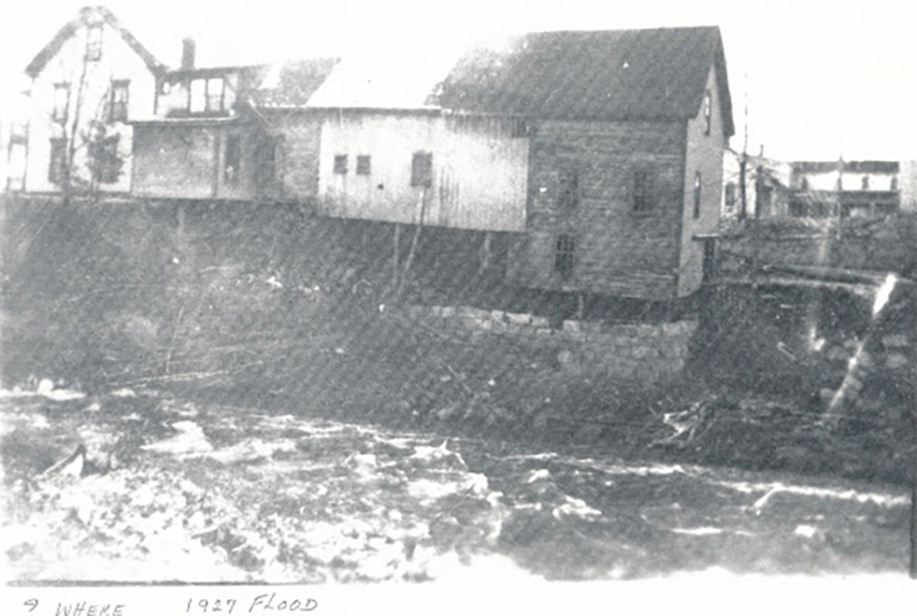
photo courtesy Hardwick Historical Society
Following stabilization, native riparian plants will be installed to strengthen the bank and support river health. Planting will occur after construction, once the ground has settled.
A second property on Brush Street has entered the federal buyout program as well.
Flooding in August 2024 damaged the adjacent 65 Brush Street. That property is expected to transfer in early December. The state anticipates demolishing it before the end of the year. As with 41 Brush Street, once the site is cleared, future stabilization and restoration work will support both the neighborhood and the river corridor.
The work on Brush Street reflects the layered nature of disaster recovery work. Fire, flood, engineering, federal programs and waiting have resulted in steady progress.
This project has removed a dangerous structure, will stabilize a vulnerable riverbank and add long-term protection for the neighborhood and public infrastructure.
In time, the site will shift from damaged ground to a stable river edge and eventually to a small, quiet section of natural buffer along the water.
It has been a difficult chapter in this corner of town. The steps now underway lead to safety, restoration and a future shaped by care rather than crisis.
Kristen Leahy serves as the Town of Hardwick Zoning and Floodplain Administrator and the Resilience and Adaptation Coordinator.


