
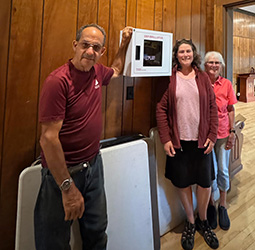

GREENSBORO – For 2025, funding to purchase three automated external defibrillator (AED) for strategic public locations within the community were made possible in part by grants through the Greensboro Association (GA) and the Greensboro United Church of Christ (GUCC) Pleasants Fund.
The Pleasants Fund provided a $2,500 grant relating to placing an AED at the GUCC, while the GA grant for $5,150 covered AED stations at Willey’s Store and Smith’s Grocery.
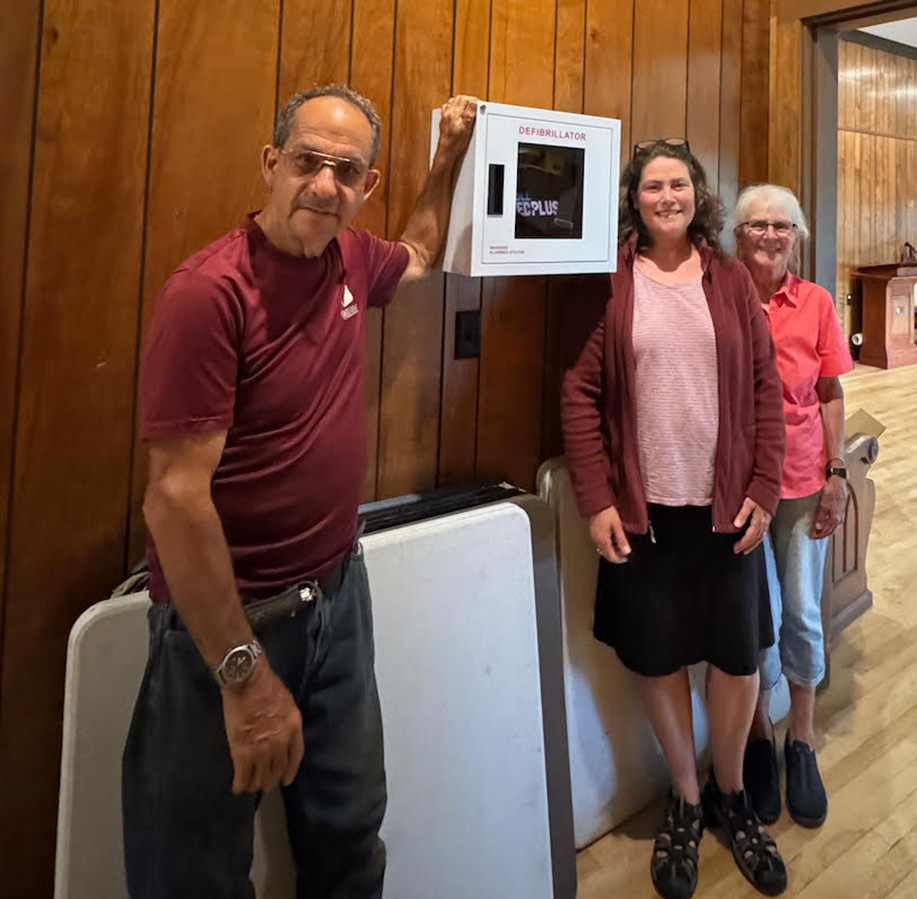
Photo courtesy of Karl Stein
Funding also supported training employees of the stores and nearby community organizations in CPR and proper use of the AEDs.
Sudden cardiac arrest is a pathological process that causes a person’s heart to stop pumping blood through the body. The person may collapse, lose consciousness and be pulseless. In these cases, CPR without delay and early application of an automated external defibrillator (AED) dramatically increases the chance of survival.
In rural communities, access to emergency medical services can take several minutes when seconds count. Survival from cardiac arrest decreases with every minute that passes with no intervention.
Access to AEDs and training to provide CPR are essential to increasing survivability.
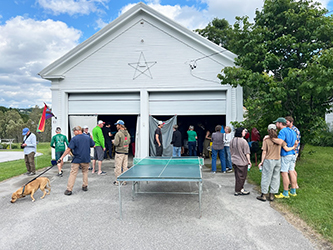
Hardwick Rescue’s Training Officer, Tyler Molleur, a paramedic and EMS provider for 15 years, volunteered time, along with Greensboro’s Health Officer and Medical Reserve Corps Volunteer Training Coordinator Karl Stein, to provide formal CPR training to nearly 40 members of the Greensboro community.
Stein was also able to secure bleeding emergency kits for all participants through the Medical Reserve Corps.
The GA previously provided grant funding in 2024 to expand the cache of training equipment for the rescue squad to deliver CPR training. The squad is now working to offer monthly courses on a rotating basis throughout the communities it serves in 2026.
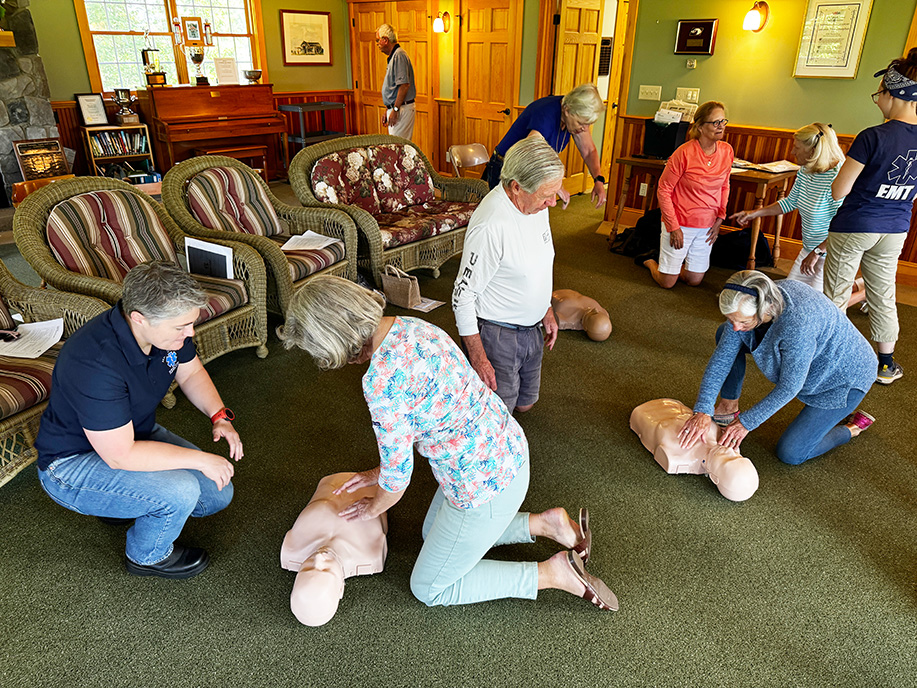
Photo by Karen Gowen.
Successful models of programs exist, with local connections bringing those models to Vermont communities.
In 2023, the University of Vermont’s efforts were recognized as the institution earned a Heart-Safe Campus designation. The University also provided the program that spearheaded those efforts, earning a 2023 safety award.
Molleur, a clinical assistant professor at the University of Vermont, trains emergency medical services and nursing students to provide CPR education to the UVM campus community through the Catamount Emergency Care Program. The program is student-led with supervision by key faculty and staff advisors and offers biweekly courses to the campus as well as special CPR events throughout the year. The program has also expanded access to emergency response equipment on campus, such as AEDs, Narcan, and bleeding control supplies since its inception in 2022.
Cardiac Arrest Registry Data Shows Value Of Public Response Resources
In the Hardwick Rescue service area in 2024, there were three incidents where return of circulation occurred after a cardiac arrest. In all of these cases, bystanders or first responders initiated rapid application of an AED and performed CPR immediately. Molleur says no matter how quickly an EMS unit can respond, what is done while waiting for help to arrive is critical to patient outcomes.
“Even calling for help and providing hands-only CPR, which is pushing hard and fast on the center of an adult’s chest if they are unresponsive and not breathing normally, is dramatically increasing that person’s chance of survival until additional trained help arrives,” he says.
The three-hour CPR course that is offered also teaches nuances when it comes to caring for pediatric victims, how to address a choking emergency, and when to use naloxone. It also gives learners multiple opportunities to practice with equipment before an actual emergency occurs.
Visibility of AEDs Is Important
Under Vermont law, any business or community organization that has an AED must register their device with the Vermont Department of Health under their AED registration tool, found a healthvermont.gov/emergency/emergency-medical-services/policies-documents-forms-and-meeting-minutes. That website also provides information for grant funding to purchase new AEDs.
“The Vermont Department of Health AED map and phone-based apps such as PulsePoint AED can allow members of the public to locate an AED in real-time in the event of an emergency and send someone to retrieve the device,” Molleur says. “An AED that is not visible is just about as useful as having no AED at all.”
Molleur says eight AEDs are currently registered in the Hardwick Rescue coverage area, including the three new Greensboro locations. He suspects that is a dramatic under-representation of the number currently available.
More information on CPR courses being held by Hardwick Rescue will be available in January. Find those course listings on its website, hardwickrescue.org.


