


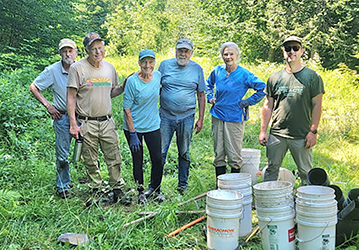

CRAFTSBURY – The Craftsbury Conservation Commission (CCC) began a Japanese Knotweed (JK) demonstration project in 2017 to show landowners ways to eradicate or at least control the non-native invasive plant.
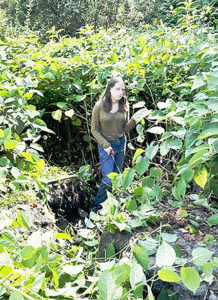
photo by Elinor Osborn
The project site, across from the Little Hosmer fishing access in Mill Village, is owned by the Vermont Department of Environmental Conservation under the administration of the Vermont Department of Fish and Wildlife. It was chosen because of its roadside visibility at a well-traveled intersection.
In 2018, a licensed herbicide applicator demonstrated injecting large stems of JK with glyphosate. That method was costly, time-consuming and didn’t control as completely as expected.
There are always apprehensions on using herbicide, so we abandoned that method.
Other methods demonstrated at the site have been pulling, cutting, mowing and smothering. We demonstrated how to dry stalks with and without roots.
In 2024 the Craftsbury Conservation Commission received a Watershed Grant from Vermont Fish & Wildlife to start a new experiment using erosion fabric, plantings and fascines (bundles of fast growing willow) to stop erosion flowing from the gravel road into the Little Hosmer Pond outlet stream.
It was expected that Japanese Knotweed would prevent erosion, but it doesn’t. It doesn’t have a tangle of fine roots as many native plants do, so soil moves easily between the widely spaced JK roots.
JK roots are brittle and break off into the moving soil to be carried into the stream, floating downstream and taking root in a new spot. You have probably seen streams and rivers in Vermont edged thickly with JK for long stretches.

photo by Elinor Osborn
The conservation commission, with more than 999 hours of volunteer help from Craftsbury residents, Sterling College students and Craftsbury Outdoor Center athletes, dug up a large eroding area of JK adjacent to Town Highway (TH19} in 2024 and 2025.
The steep slope, which had eroded in the previous summer’s flooding, was then covered with erosion control fabric to smother the JK roots.
More than 200 Vermont native, bare-root shrubs were planted In May 2025 through slits in the fabric along TH19. The plants were chosen for their ability to thrive under dry, sunny conditions; to grow a thick root cover from their rhizomes to hold soil in place, outcompeting knotweed; and to attract pollinators, birds and other wildlife.
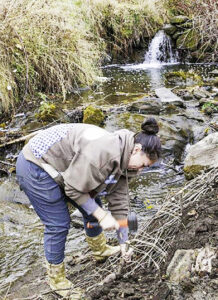
photo by Elinor Osborn
The native shrubs are Arrowwood (Viburnum dentatum), Red Osier Dogwood (Cornus sericea), Chokecherry (Prunus virginiana), Black Chokeberry (Aronia melanocarpa), Gray dogwood (Cornus racemosa), Nannyberry (Viburnum lentago) and Purple-flowering Raspberry (Rubus odoratus).
Nearly all of the shrubs were doing well late in the growing season.
It remains to be seen whether the fabric and the plants will control erosion from the road, smother the JK and help crowd it out.
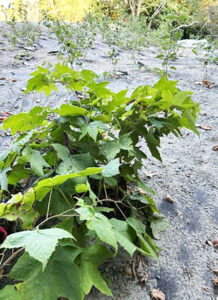
photo by Elinor Osborn
When JK covers large areas and crowds out native plants, wildlife is lost, including pollinators. Birds don’t nest in it and it doesn’t produce berries for wildlife food. Bees use it only when it’s in bloom. But they need an assortment of flowering, nectar-bearing plants all spring and summer, not just one spread of all the same blossoms only in late summer.
In the fall of 2025, native grass seed with asters was planted to control erosion at the road shoulder.
Both Hyde Park and Waitsfield-Warren-Fayston (WWF) are proving that mechanical control of JK is working. I visited WWF last summer and was amazed at how much they have accomplished in clearing large areas of JK. Hyde Park says “repeat cutting [of JK] absolutely works to deplete the plant’s energy. You have to be realistic about the work required: It takes time and persistence over many years.”
The CCC experience shows that is so true. Our job in 2026 will be to keep pulling up JK as we know it doesn’t give up easily. But each pull weakens it and eventually it will give up.


