

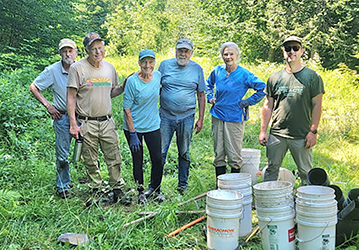

HARDWICK – Recently, I spent a bitterly cold afternoon walking through several flood-impacted sites in Hardwick with a group of University of Vermont students. They are enrolled in a course on climate adaptation and are thinking about what towns manage after buyouts are complete.
We were standing in places where water flowed in 2023 and again in 2024. The ground was uneven, and in a few spots the river was still actively reshaping the landscape. That felt appropriate. “After” is rarely a settled condition.
Buyouts are often described as an endpoint. A property is acquired, a structure is removed, and risk is reduced. But standing in these places, it becomes clear that buyouts do not end the work. They change it.
In Hardwick, we have completed or are in the process of completing twenty flood-related buyouts following the 2023 and 2024 floods. These are homes that experienced repeated inundation, severe erosion, or both. In some cases, residents had real choices to weigh. In others, continued occupation or rebuilding was no longer realistic.
Once a structure is gone, the land remains. So does the river. And so do the responsibilities.
As we moved from site to site, I talked with the students about sequencing. In practice, the order in which towns act, wait or pause often matters more than any single project. Moving too quickly can close off options or unintentionally pressure people who are still deciding whether to participate in a voluntary program. Waiting too long can leave risk unaddressed. Much of the work after buyouts is finding a balance.
Vacant parcels continue to flood. Riverbanks keep eroding. Funding programs move on different timelines. Some sites are cleared while neighboring buildings remain in place, waiting on decisions that have not yet been made. What follows a buyout is often a long stretch of interim conditions. The land is neither restored nor abandoned, but actively managed.
At one site, technical studies suggest that future restoration could reduce flood impacts both upstream and downstream. Several properties there are still in the buyout process. I explained why the town has chosen not to advance a detailed concept yet. It is not because there are no ideas. It is because preserving agency matters. Advancing a plan too early can make a voluntary decision feel predetermined.
At another site, multiple federal programs are addressing related risks, including acquisition, stabilization and hazard mitigation, but they cannot be combined. I described how towns end up managing land, communication and safety across overlapping efforts that were never designed to line up neatly.
What I hoped the students took away is that the period after buyouts is less about construction and more about stewardship. Towns become caretakers of land, risk and expectation. The work is quieter than demolition and slower than design, but it carries long-term consequences.
As more communities face flooding and erosion, buyouts will remain part of the conversation. Understanding what comes after, the sequencing, the waiting, the coordination and the responsibility, is just as important as understanding how buyouts work in the first place.
Standing in these places with students, it was clear that adaptation does not happen all at once. It unfolds over time and relies as much on judgment as it does on technical solutions.
That is the part of the work that continues long after the buyout is complete.
Kristen Leahy is the zoning and floodplain administrator and resilience and adaptation coordinator for the Town of Hardwick.


