
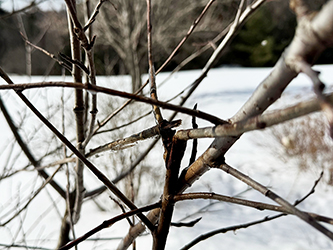


NORTH ADAMS, Mass. – Just because there’s snow on the ground doesn’t mean there’s nothing to do in the garden until spring. Late winter is often the best time to prune many deciduous trees and shrubs while they’re still dormant.
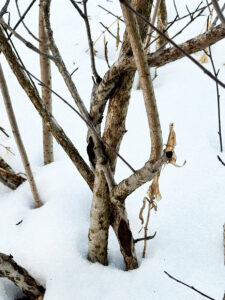
photo by Debra Heleba
Pruning during dormancy poses less stress on trees and shrubs than when they’re actively growing. The absence of foliage allows unobstructed observation of their structure. It’s easier to identify damage and crossing limbs and to assess their overall health.
Look for broken, damaged, crossed or diseased branches to be removed. Check for limbs that meet the trunk at a narrow (less than 45°) angle. They’re more likely to be weak and susceptible to breaking. Consider whether branches should be thinned, making foliage less dense and allowing more light in and better air circulation to help minimize foliar diseases. Once it’s determined what needs to be done for the plant’s health, consider whether pruning might improve or maintain shape or height.
While many trees and shrubs benefit from late winter pruning, some don’t. Avoid late winter pruning of plants that bloom in early spring, such as lilacs (Syringa), azaleas (Rhododendron) and forsythia (Forsythia), or there will be fewer flowers this year. They set buds soon after flowering and are best pruned right after their flowers fade.
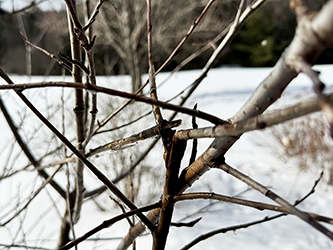
photo by Debra Heleba
If growing hydrangeas, before pruning confirm that the variety blooms on new wood, such as Hydrangea arborescens (smooth hydrangea) and Hydrangea paniculata (panicled hydrangea). On the other hand, Hydrangea macrophylla (big leaf hydrangea) and Hydrangea quercifolia (oakleaf hydrangea) bloom on old wood and shouldn’t be pruned in late winter.
Basic tools include bypass-style hand pruners which are useful for trimming small branches. Loppers come in various sizes and can handle branches up to two inches in diameter. A pruning saw works best for larger branches.
Be sure tools are clean and sharp. Injury can be caused by a dull blade, and it’s more difficult to make a clean cut. A dirty blade could spread disease, even in winter. Wear eye protection and gloves for safety.
Take the time to assess the shrub or tree and decide on an end result before making the first cut. Prune judiciously. Additional pieces can always be removed, but it’s impossible to undo a careless or excessive cut.
Select a branch and locate a bud to identify a node near where to cut. Prune just above the node (bud), cutting downward at a 45° angle. This helps avoid moisture accumulation that could encourage disease.
If removing an entire branch, cut outside the branch collar (the area of raised bark where the branch emerges), but don’t leave a large stub.
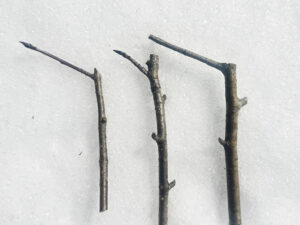
photo by Debra Heleba
Disinfect pruning tools between cuts. This is particularly important when removing diseased parts. Don’t compost diseased prunings.
Prune thoughtfully. Plan cuts. Avoid cutting straight across the top of the whole plant in an attempt to control growth. Often referred to as “topping,” this can encourage fast, weak growth and damage the tree or shrub’s health.
To avoid stressing the plant, don’t remove more than one-third of a shrub or tree.
If pruning to rejuvenate a mature shrub, select no more than one-third of the largest and oldest branches and cut them back to the ground. Reduce height by pruning the remaining branches by one-third, back to a bud. Do the same for the next two years.
Deborah Benoit is a UVM Extension Master Gardener who volunteers as a garden columnist from North Adams, Mass., and participates in Bennington County Extension Master Gardener Chapter activities.


