



EAST HARDWICK – For many in the New England region, spring showers aren’t the only expectation for the season. Many families anticipate the sweet smell of boiling sap, one that can only be found in and around a sugarhouse.
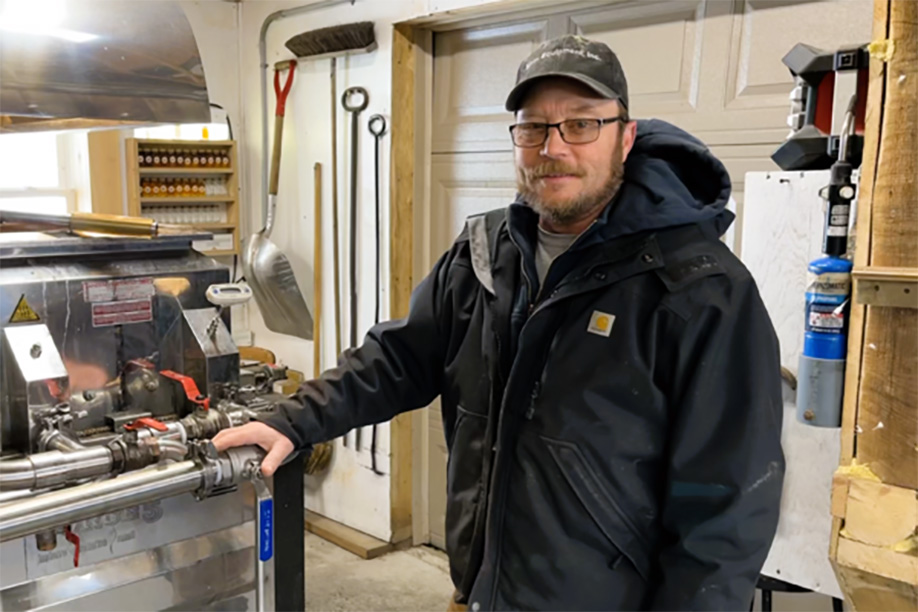
Shawn Messier of Mountainside Orchards, the Messier Family Sugarhouse and the Vermont Maple Sugar Makers Association Caledonia County Director says, “we had a record season,” making 325 more gallons with 700 fewer taps. He is a second generation sugarmaker, starting with his father in 1972.
For some, acquiring maple syrup or a maple treat is as simple as getting in the car and finding your nearest store. For others, dedicated maple producers, the process is far longer. The state of the Vermont maple industry can be fickle, reliant on the weather and thus changing year to year.
Caledonia County Director Shawn Messier of the Vermont Sugar Makers Association, as well as the Caledonia Maple Association provided some insight into how this year’s sugaring season went for the area, as well as developments in maple syrup production methods.
Messier is a second-generation sugarmaker. He began sugaring in the Hardwick area with his father in 1972. Now he runs the Messier Family Sugar House with his partner Deb.
“Everyone that I have talked to in this area was about average. Whereas last year, the year before, were slightly above average, three years ago was way below average in this area. So this year we kind of return to what we would consider normal production,” Messier began. However, he explained there are nuances to be found in operations even just miles apart.
“I have heard of a couple of people that had a better than average year. Why? I’m not sure. They’re pretty close in proximity to most of the rest of us that had just an average year. So, there’s so many little intricate, minutias, that every area can be different.”
The weather conditions are of the utmost importance. Even a slight difference in temperature can impact the outcome of the season, explained Messier, “A lot of times the season depends on the difference of two degrees. If it had been two degrees warmer, it would have run, if it had been two degrees colder, it would have frozen overnight, and it had a better run the next day. Two degrees can make or break a season.”
Three years ago, as many maple producers in the state can attest, that’s the way it was. “We just never, never quite got warm enough. So many times, and so it was a very poor year,” he recalled.
Things have turned around, however, over the last two years, Messier said, “The stars have aligned and things worked well for us. This year was just kind of back to our baseline average.”
Of his own operation, he says “We made just over four pounds per tap, which I like to consider my baseline average.”
Messier talked about the growth of reverse osmosis (RO) in the area, “I would say most sugar makers in the area of any size at all now use reverse osmosis. There’s not many producers, beyond hobby, that don’t use it. Because of the wood you would need or the oil or propane, whatever you’re using in your evaporator for a fuel source. By using the reverse osmosis, you’re cutting that, the need of that source by 75%.”
Reverse osmosis is not an entirely new development, having been in the maple industry for around thirty years. Messier says as operations change and get larger, the process has become more popular.
“It used to be scary to some people, and now I think people understand that it’s a necessity. It really is. If you’re just a hobbyist, then you don’t mind sitting in your lawn chair and boiling sap for a long time to make a gallon of syrup, but if it’s something that you hope to earn a living or even a supplemental income, you have to find ways to make it more efficient and RO is probably the largest single item that can help with your efficiency.”
He explained further, “Using the Jones’ rule of 86, if your raw sap that you get from the tree is, say it’s 2% sugar, which is a general average. Some years are more, some years less, some areas are more, some areas are less, but at 2% sugar on your raw sap, it takes 43 gallons to make one gallon of syrup. So if you use reverse osmosis and take that to, say 10% sugar content, it takes 8.6 gallons that you have to boil to make one gallon of syrup.”
That’s a stark difference, especially in consideration to the growing prices of fuel.
He continued, “If you’re producing any volume, you almost have to have it. If you were burning fuel oil, boiling raw sap, you’re going to use several gallons of oil to make one gallon of syrup where, with reverse osmosis, you can be down to less than a gallon of oil to make a gallon of syrup.”
Messier still burns wood, and the difference there is clear too, “It means burning 10 cord of wood a year instead of 40. The manpower needed to cut and split and stack 40 cord of wood is tremendous. Whereas the 10 cord, that’s doable.”
Other aspects of making maple syrup have changed too, with the production of syrup and other maple products becoming more regulated, said Messier. Safety is crucial, he emphasized.
“You’re making a food product, you’ve got to be concerned with lead in your production equipment, making sure that you don’t have anything that is lead, lead soldered pans, things like that can introduce lead into your syrup. You’re making a food product. Unless you’re giving away everything you’re making, if you’re selling a food product, you’re required to meet certain guidelines that the food and drug administration (FDA) has out there and one of them is lead in your syrup.”
The FDA retains the right to come and inspect maple operations at any time. Messier says it’s important for maple producers to be vigilant and aware.
“Don’t store your gas cans in the sugar house, things like that. You’re making a food product. You have to treat it as such. For a lot of years, maple production was something that farmers did in the off season and things like that, and it kind of got treated as just a little sideline, but if you’re selling your product, you have to treat it as a food product, because that’s what it is.”
In addition to customer safety, their experience is just as important, Messier explained, “That’s something everyone needs to think about, because you don’t want to sell an inferior product either. Because that gives maple in general a bad name. For somebody that’s never had maple syrup . . . Well, you’re never going to have them as a customer. So you need to make sure you’re only producing a quality product.”
According to Vermont Business Magazine, Vermont is the top producer of maple syrup in the United States, contributing over 50% of the nation’s total, with New York coming in second. Notably, “Vermont has, I would say the most active enforcement of maple oversight and always has. The Vermont Sugar Makers Association (VSMA) is, as far as I am aware, the oldest, kind of oversight, for maple in the U.S., It’s been around for a long, long time . . . That is important.”
Formed in 1893, VMSMA is one of the oldest agricultural organizations in the United States. The association is made up of Vermont maple sugar makers, maple packers, equipment manufacturers and other industry leaders.
Messier had a final fact that will surely please maple consumers: “There’s a lot of good health things with maple syrup. It’s high in antioxidants and it’s actually good for you,” he says.
“There are definitely bonuses, not only in the fact that it tastes good, but it is relatively good for you as far as natural sweeteners go.
“I don’t know anything that would be better for you,” concluded Messier.

Raymonda Parchment is a Hardwick Gazette reporter. She recently graduated from Vermont State University - Castleton with a Bachelor’s Degree in English. She is a strong supporter of freedom of speech, and the right to publish information, opinions, and ideas without censorship or restraint. She is a lifelong lover of the written word, and is excited to join the team as a staff member.


