



GREENSBORO – On April 16, with the ice departing, the “Call of the Loon” returned to Caspian Lake. This call evokes feelings of wildness, solitude and mystery, so a pause welcomes its return.

photo by Stew Arnold
The next day a pair of loons is seen swimming amongst the remaining few ice floes. Ah, they are back, to be enjoyed, witnessing their dives and returns to the surface many feet away. Their mysterious underwater travels; how far, how fast and whether they will arise with a minnow in their beak for dinner.
Caspian Lake now has a steady number of loons each summer, mostly between 12 and 18 when annually counted.
Loons have made a good recovery state-wide, from very endangered low numbers of years past. In 2017, a pair attempted to build a nest on the Caspian Lake shore and was challenged by a raccoon. Eric Hanson, Vermont Eco-studies biologist, brought a raft with native foliage to assist with a safer nesting spot. The pair liked this option and quickly made it a home for two eggs. Just under a month later, Caspian Lake had its first pair of chicks in many decades.
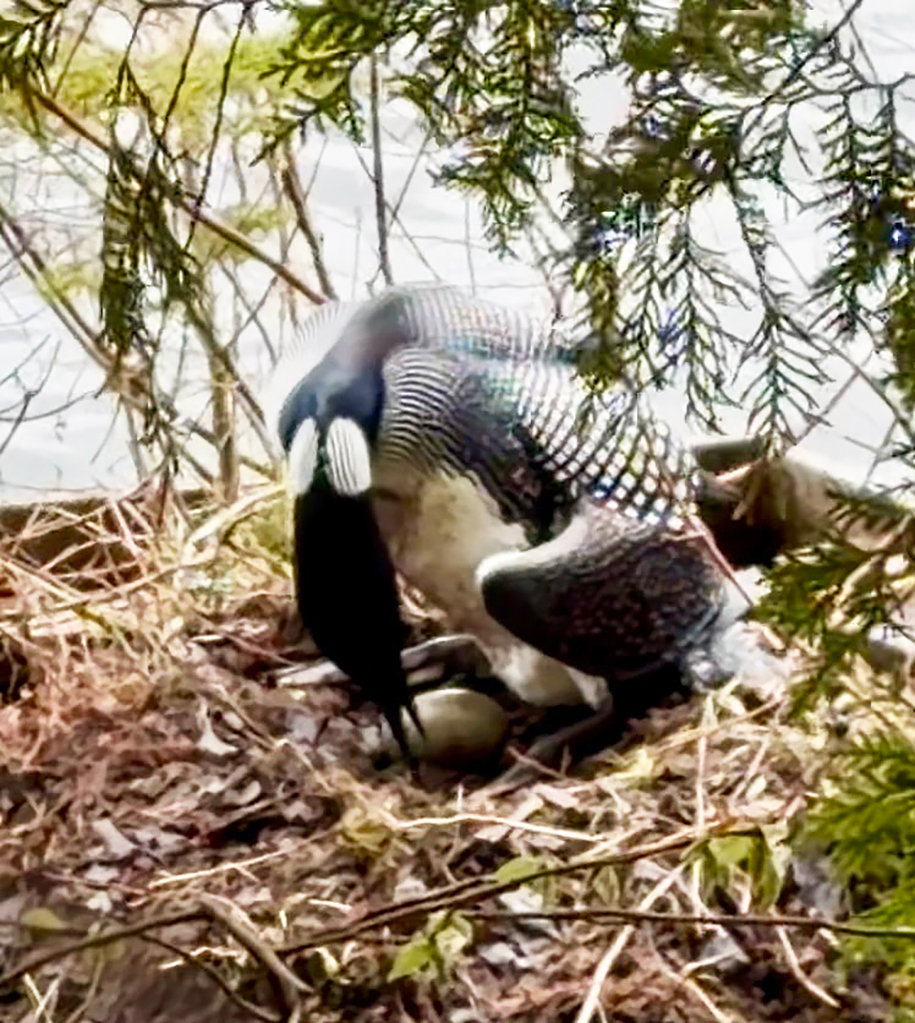
photo by Stew Arnold
This April 23, the raft was readied in position for the tenth year, under the watchful eye of the mating pair. While they give the raft some interest by floating nearby, they typically wait until mid-May to climb aboard. It is only a guess that this is the same pair from year to year. Not completely certain as there have been two different intruder loon battles in the past few years, with one most likely changing the partnership.
Each of the nine prior years has produced a pair of eggs, totaling 18 eggs. One of the intruder battles occurred when eggs were in the nest, leaving them unattended for incubation for half a day thus those two eggs never hatched.
So, nine years has produced 16 chicks. The second intruder battle happened when the chicks were about one month old. That battle resulted in one parent and one chick escaping to the other side of the lake. A chick did not survive and the other parent’s fate was unknown.
Caspian Lake is assured it has raised 14 chicks to be juveniles. Last year, a juvenile was victim to an eagle. Another year a juvenile went missing towards the end of summer with its fate unknown.
In the past nine years, 13 juveniles have launched themselves in the fall to travel to ocean shores near Rhode Island and Connecticut. They will grow to adults on the ocean for three to five years before returning for summers back in Vermont and very likely to a waterbody within 25 miles of their birthplace. The successful increase is to be celebrated.
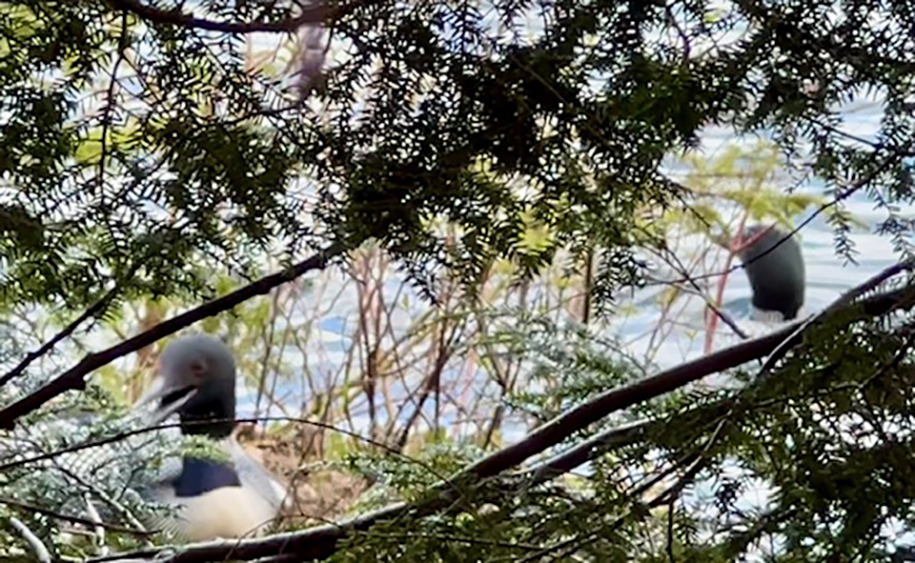
photo by Stew Arnold
Raft checks in early May found no loon on the nest yet. Nearby, an active pair were seen regularly claiming territory. “Hello Friends” makes a good reply to their quiet “Hoots.”
A May 15 raft visit showed a parent on the nest. After about 15 minutes, the parent stood for a stretch and a single egg was seen in the nest bowl. After a quick egg turn, the parent settled back down on the egg where they are known to sit for hours. Loons are likely to lay an egg and follow with laying a second egg the next day. Loons are also “biparental.” Both male and females incubate and care for chicks equally.
To give the new loon parents safe space, four warning signs were set afloat around the small cove protecting the raft. The signs let boaters and kayakers know to keep clear of the area.
A day later a parent is laying in the nest bowl. Is it the male or female? The black and white loon patterns are identical, thus males and females can not be told apart visually. If side by side, their size can identify the sex as the males are about 25% larger.
How many eggs were there I wondered? Plus, how long will I have to wait to find out? The partner loon returned to raft, circled and dove, then floated around.
The loons hooted soft coos to each other, then the partner went off fishing. Fifteen to 20 minutes later the partnership pattern repeated, but there was and still no exchange of duties.
After an hour and a half, the nesting parent sat up. I hoped we’d see if another egg had been laid, but the parent sat back down. How much longer would it be? Before, one could even sneeze, the parent was up again, showing a clear view of two beautiful eggs.
Caspian Loons are back at it again!
Incubation of loon eggs takes about 26 to 29 days to hatch. It’s a guess. May 15 and 16 egg laying will make the hatch date be about June 10 to 12. What happens next? Do we have a cliff-hanger?
Come hear the egg hatching results at the Highland Center for the Arts talk celebrating the 50th anniversary of the Vermont Loon Conservation Project, June 20, from 3 to 4 p.m., during a reception for the “Call of the Loon” show which runs there from June 11 to 21.


