

DUXBURY – Standing on the berm of a small pond, I watch the resident beaver leave its lodge, a silhouetted nose moving through the water. It disappears briefly and returns with a branch in tow. The beaver clambers over the edge of its dam along a muddy path, branch bouncing[Read More…]
The Outside Story

Skunks Prepare for Winter
WALTHAM, Mass. – Several weeks and many baths ago, my dog discovered a black-and-white stranger crossing our lawn. Wagging vigorously, and ignoring my frantic shouts, she ran up and offered her canine greeting: a nose-to-tail sniff. The encounter ended predictably, with the skunk waddling off into the dark, the dog[Read More…]

A Boxelder for Terry
WALTHAM, Mass. – My friend Terry Gulick, who passed away earlier this year, used to tease me about my favorite yard tree. Terry did a lot of gardening jobs, when he wasn’t mentoring kids, and he was amused, and a little offended, by what I’d allowed to grow up in[Read More…]
Fallen Logs Invigorate Stream Life
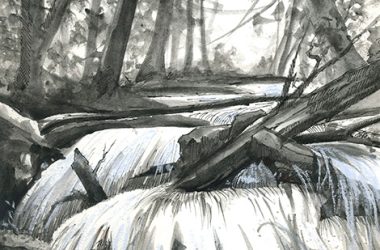
BURLINGTON – For 12 summers, my Vermont colleagues and I offered guidance to high school student and teacher teams who conducted research on streams as part of a National Science Foundation EPSCoR program. These teams received training in July, and for the rest of the summer and early autumn, employed[Read More…]

Petrichor is a Scent of Rocks and Rain
DUXBURY – When I hug my son after a day of fall bouldering, his hair smells of the sun-warmed rock we’ve been climbing over. It’s a distinctive odor, evocative of gray ledges and golden light returning after rain, and yet it’s not the rock I’m smelling, but tell-tale traces of[Read More…]

Closing Time: How (Some) Turtles Shut Their Shells
COVENTRY, R.I. – In cartoons, when a turtle is spooked, it retreats into and closes up its shell. While used for comic effect, this imagery is based in fact, although not all turtles are capable of this protective feat. In the Northeast, there are three native turtle species that have[Read More…]

Wood Turtle at Risk in Vermont
VERMONT – While spiny softshell turtles are threatened in Vermont and spotted turtles are endangered, wood turtles could soon be threatened in the state due to land use change. That is why the state’s Fish & Wildlife Department is watching the species closely before more serious intervention is required. The wood turtle, a[Read More…]
Mudflat Wanderers
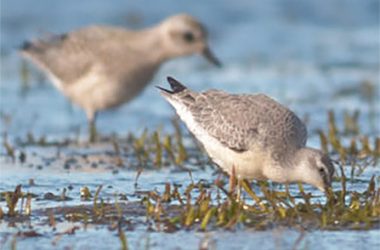
WHITE RIVER JUNCTION – Autumn bird migration in Vermont often brings to mind graceful flocks of Common Nighthawks and Canada Geese wheeling their way south, or perhaps the famously confusing fall warblers that move through the state in huge numbers. In this land-locked state, one would be forgiven for overlooking[Read More…]

Citizen Science Key to Preserving Monarch Migration
PUTNEY – “The only way we know a lot of this stuff is because thousands of people have helped us collect data across the landscape,” one Vermont expert said. From August to November the members of Putney Mountain Hawkwatch stand on the summit of their namesake spotting and surveying migrating[Read More…]

Radiant Red
WHITE RIVER JUNCTION – Bright red leaves under a clear blue sky make for a spectacular sight, but what strikes us as simple beauty could mean survival for a tree. As green chlorophyll breaks down without replacement, we begin to see the underlying orange and yellow carotenoids characteristic of our[Read More…]

Vermont Beach Plants
WHITE RIVER JUNCTION – As the Vermont summer comes to an end, we want to spend a little more time thinking about beaches. Our minds might drift on warm afternoons from the state’s famous green mountains to distant, sandy shores. Yet while there is no coastline in Vermont, sandy beaches[Read More…]

Benefits and Misconceptions of Digger Wasps
NEW ENGLAND – On warm days through early fall, you can find two large species of digger wasps flitting about late-blooming flowers. Like many wasps, these species elicit strong, often negative reactions in humans. But digger wasps inhabit a critical niche in invertebrate communities and can lend a natural hand[Read More…]


