

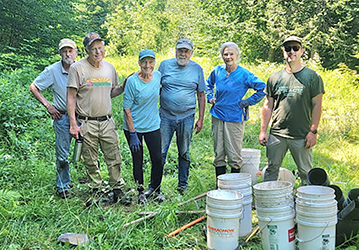

HARDWICK – Recently, we saw a perfect example of what a determined, small community can achieve. Wolcott, one of the smaller towns in our supervisory union, was recently highlighted on Channel 3 WCAX for exceptional community work on bike trails that run through the forest adjacent to the school. While not finished completely, the initial trails are of exceptional quality. Those who have ridden them note their world-class potential.
The Wolcott community could see that they needed something to bring their community together and to attract others to their community. They were forward thinking and they continue to look to the future in community-planning. Their ultimate intent is to make Wolcott a destination town with flourishing businesses, restaurants and other recreational possibilities. In an effort to attain that goal, they also partnered with several agencies, including the school district, to completely upgrade their waste management system. This was no easy feat. They needed support from their taxpayers, the school district, and other agencies. They got all of that support, and they continue to persevere.
Wolcott is an example of why we need to be so careful as the state goes about redistricting in accordance with Act 73. I have reported on this Act in previous communications, but suffice it to say, the Redistricting Task Force, as of this writing, has met three times. These are full-day meetings. The task force is tasked with making up to three recommendations on redistricting to the state legislature. They will provide the associated maps related to the district changes. The legislation calls for supervisory unions or districts that have between 4,000 and 8,000 students. OSSU comes nowhere near that. We would need to merge with at least four other supervisory unions to meet that minimum number.
There are two types of organizational structures for schools in Vermont. The first is what is commonly referred to as a district. Examples would be Burlington or Hartford. These have one controlling board and one budget for all the schools in their catchment area.
The second organizational structure is what we have experienced, commonly called a supervisory union (SU). Typically, these have one supervisory union board that oversees all centralized services and distinct local boards that have the ultimate authority over the individual districts, including developing and adopting the final budget. So, you can see that the commission deliberations could seriously change the way we have done business as an SU. Boards are gathering some public input, and several of us, including me, are trying to attend these task force meetings. They are open to the public and have a virtual option. Agendas can be found on the Vermont Agency of Education website. Upcoming meeting dates as of this writing are: October 10, October 28, November 10 and November 20, from 9:30 a.m. to 3:30 p.m., with locations and meeting links added to the website as confirmed, at aoa.vermont.gov/upcoming–meetings–school–district–redistricting–task–force.
No decisions have been made, and the state legislature will have to adopt any changes that are recommended.
This report has been excerpted from the October Message from OSSU Superintendent Dr. David Baker

Dr. David Baker
Dr. David Baker is the Orleans Southwest Supervisory Union Superintendent


