


VERMONT – Before Edie Perkins heads out to explore a new trail, she runs through a mental checklist.
Is there accessible parking? How far is it from her car to the trail? Is the surface hard-packed or uneven? For most people, those questions barely register. For Perkins, who uses a wheelchair, they determine whether she can venture out at all.
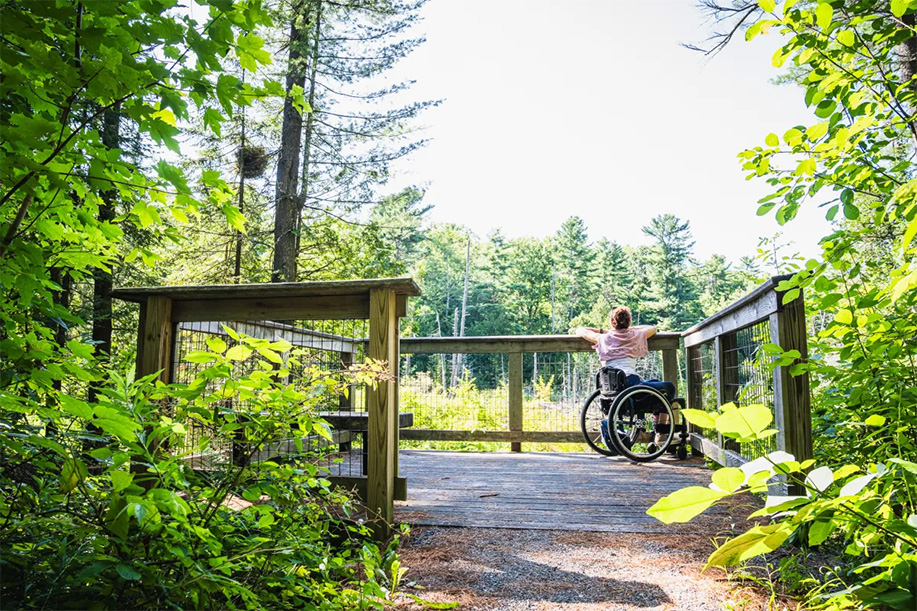
“Exploring new places is always exciting. It can also be a little frightening…there are so many things that able-bodied people don’t understand about accessing the outdoors,” she said.
Perkins, a lifelong cyclist who lives in South Burlington, was paralyzed from the chest down in 2017 after a car hit her while she was biking. Now she uses a wheelchair or a hand-cycle on trails. Recently, she visited the Vermont Institute of Natural Science (VINS) in Quechee, a forested campus known for its treetop boardwalk and network of accessible trails.
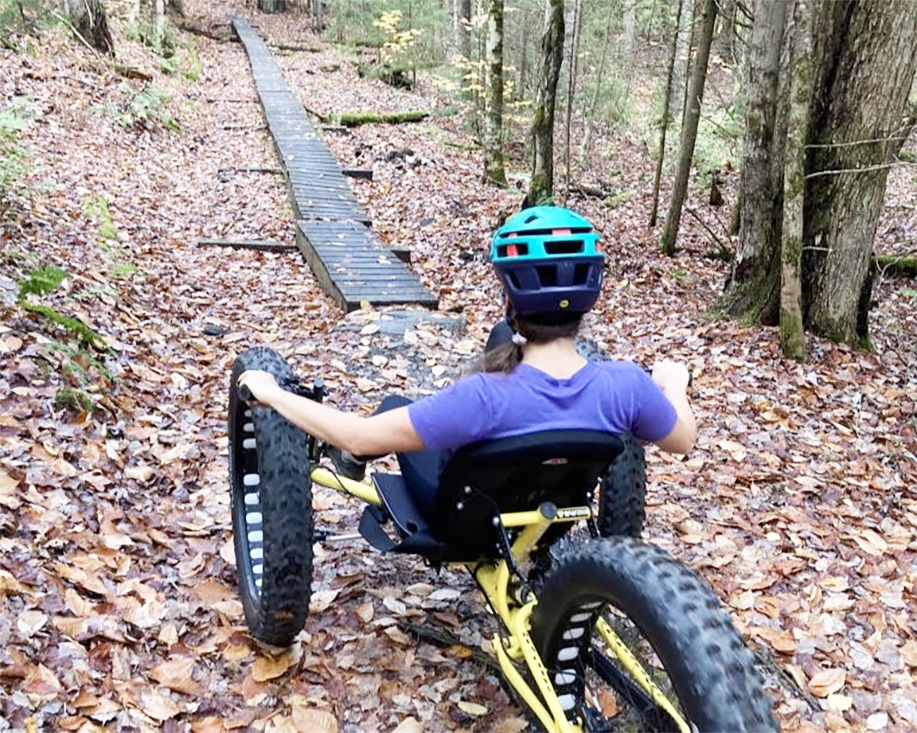
VINS’s trail system was improved with support from the Upper Valley Trail Alliance (UVTA), a member of the Vermont Trail Accessibility Hub (TAH). The Hub is a statewide initiative led by the Vermont Trails & Greenways Council (VTGC), and a partnership of six organizations working to expand access to trails for people of all abilities.
“We believe forest immersion is not just for the young, fit, and able-bodied. With the help of partners like UVTA, we’ve sought to make our woods accessible to all,” said Alden Smith, executive director of VINS.
When barriers are removed, Perkins says, everything changes.
“Everything at VINS felt thoughtfully designed for accessibility without losing that wild, natural feel. The paths are subtle, the views are incredible, and the experience left me grinning ear to ear…the sense of peace was exactly what I’d hoped for, ” Perkins wrote in a post she recently wrote about VINS for Trail Finder.
More and more trail managers are hearing from their communities that they want more nature-based places where they can bring family members of all abilities. That rising demand is shaping the work ahead.
While Vermont is rich in trails, mountains, and scenic landscapes, when the Hub launched in 2024, there was limited, incomplete information online about accessible trails.
Trail Finder, managed by UVTA and maintained by Hub partner Community Geographics, is one of the few map-based trail databases in Vermont focused on accessibility. The free-to-use website helps trail-seekers to discover diverse, four-season trails across Vermont.
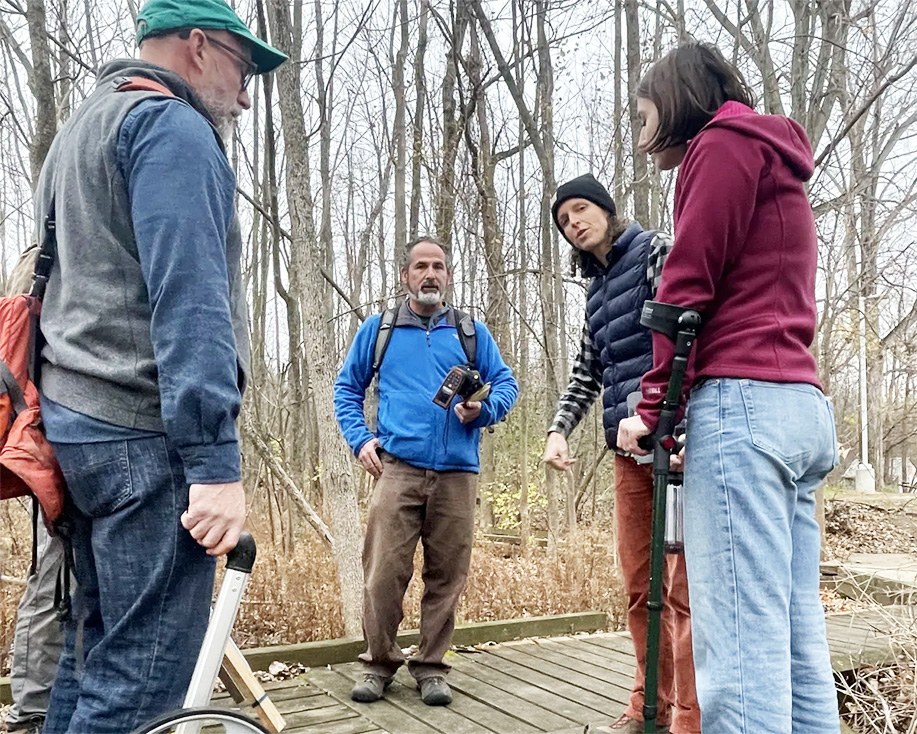
With recent grant funding, the team has added or improved descriptions and maps for over 60 trails covering 125 miles, and continues to add routes of all types, from rail trails to adaptive mountain biking. Website users can click the “Access(ible) Experience” search filter to find trails that offer greater levels of access.
“Trail managers regularly contact the Hub and UVTA for help understanding how to update their trails,” Russell Hirschler of UVTA said, “The steady flow of inquiries shows that communities want to make improvements; they just need guidance to do it well.”
It’s critical work, as Vermont Department of Health data shows one in four residents has a disability, and nearly 28 percent are over age 60, making Vermont the fourth-oldest state in the country.
Hub partner Vermont Adaptive has seen a 350% increase in demand for its inclusive sports and recreational programming over the past decade.
Expanding accessible trails isn’t just about recreation; it’s about community health, inclusion, and quality of life for everyone, from parents with strollers to older adults and people recovering from injury.
“When we talk about trails, we’re really talking about people,” says Sharon Plumb, program manager for VTGC. “Who gets to be here? Who feels welcome? What can we do to say yes to more people?”
As awareness of accessibility needs has grown, funders are increasingly taking notice.
In 2024, the Vermont Department of Forests, Parks, and Recreation’s Vermont Outdoor Recreation Economic Collaborative (VOREC) introduced an “Equity” track to its Community Grant Program, awarding grants to nine municipalities and organizations focused specifically on improving trail accessibility. Program staff say they’ve also seen an uptick in applications seeking funding to build or upgrade accessible trails.
A VOREC Community Grant supported the Hub from June 2024 through December 2025. The $644,000 award, the largest grant VOREC has ever issued, helped expand accessibility work statewide. VOREC administers Vermont’s federal Recreation Trails Program (RTP), aligning national funding with local priorities.
Since 2024, the Hub has completed 55 trail accessibility assessments with more than 30 organizations to evaluate pedestrian, aquatic, and adaptive mountain biking routes. These assessments identify the specific improvements needed to enhance access or meet established accessibility standards.
The appetite for this technical support continues to grow. When the Vermont Land Trust hosted an accessible trail-building training at Pratt Refuge in Duxbury in fall 2025, 15 trail managers attended, some traveling more than an hour, to learn directly from Hub partners about design, maintenance, and assessment. Interest in trainings like this routinely exceeds capacity, underscoring the level of guidance communities are seeking.
“The enthusiasm and support we’ve received from TAH has helped keep accessibility as a priority for our organization,” said Jenna O’Donnell, executive director of the South Hero Land Trust. With recommendations from an assessment funded by TAH, the group recently updated its Recreation Park with a new boardwalk and plans to upgrade additional trails for accessibility by 2026.
Across Vermont, this work is reshaping familiar places, many funded by VOREC’s Community Grant Program. Accessible routes now exist or are in progress at several Vermont Land Trust-owned properties, including Brewster Uplands in Cambridge and Pratt Refuge in Duxbury.
Projects with Vermont Huts & Trails at Chittenden Brook in the Green Mountain Forest near Rochester and the newly acquired Historic Goodell House at Little River State Park in Waterbury will add accessible overnight and day-use options.
Towns like Lunenburg and Randolph, along with groups such as Northwoods Stewardship Center and Tucker Mountain Forest, are advancing new pedestrian trail designs.With support from Hub partners, including The Vermont Mountain Bike Association and The Northern Forest Canoe Trail, upgrades are being made to dozens of mountain biking trails and aquatic access points.
The Hub’s success stems from collaboration and the idea of “building accessibility with, not for.”
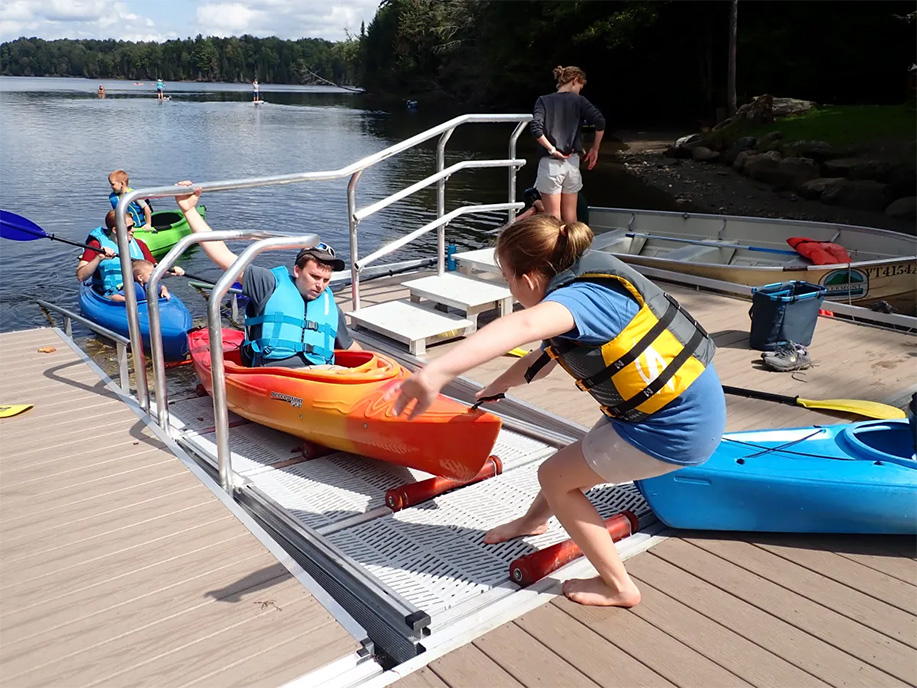
People with disabilities are more than test users; they’re leaders, assessors, and storytellers. The Hub has paid adaptive athletes to help review trails and share firsthand experiences through case studies, audio stories, and webinars.
New Hub resource pages provide detailed information on how to build accessible pedestrian trails, mountain biking trails, and aquatic entry points, along with their benefits.
At the recent Vermont Conference on Parks, Trails, and Recreation, 15 accessibility workshops featured partners including the Vermont Center for Independent Living, adaptive athletes, and a deaf trail and conservation crew.
Trail managers across the state say that without the Hub’s assessments, trainings, and technical support, they wouldn’t have the confidence or the capacity to move accessibility projects forward.
“The TAH provides important resources to groups who are eager to take the next step,” said Jeff Nugent of the Windham Regional Commission. “It informs them as to what’s possible when it comes to improving their trails, and how it can be done.”
Momentum is growing. Trail managers and disability advocates are collaborating more closely than ever before, and interest in accessibility assessments continues to exceed capacity.
Many communities now have accessibility upgrades in their long-term trail plans specifically because they’ve worked with the Hub or attended a TAH-led training.
For Vermonters likeDerek Flint, who is blind, progress means more places are opening up to him and his family.
“It feels like a sense of freedom being on a trail that is safe and not having to worry about falling off some steep inclines,” Derek said of the trails upgraded through the Hub partners. “Thank you for all you have done and will do in the future.”


