

GREENSBORO – The Greensboro Conservation Commission (GCC) voted at its September 20 meeting to contract for the application of herbicide to eradicate knotweed at two local pilot projects proposed for Highland Lodge and Smith’s Grocery.
The vote followed a presentation by commission member Chris Steel about the “basic benefits and drawbacks of mechanical versus chemical management of invasive species,” according to the minutes.
Those minutes report, “mechanical methods are viable and potentially preferable except for the fact that they require considerably more time, money and effort. For these reasons, many professional conservation organizations and contractors primarily rely on chemical treatment, as more invasive sites can be addressed in a shorter timeframe and for less money. This was why . . . he felt it was important that the GCC explore both options.”
Immediately following Steel’s presentation, the commission instead of exploring both options for the pilot projects, voted in favor of a motion saying, “that the Town of Greensboro (GCC) should work to contract professional services for the stem-injection application of herbicide to two sites of knotweed (at the Highland Lodge and Smith’s Grocery) as pilot projects. This was approved by members with all voting in favor, except Erika Karp, who cast the sole dissenting vote.”
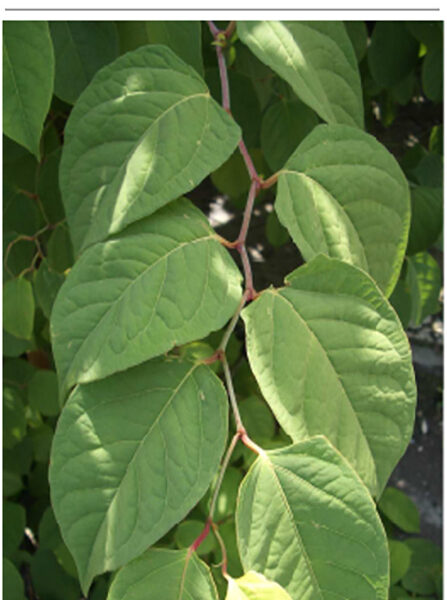
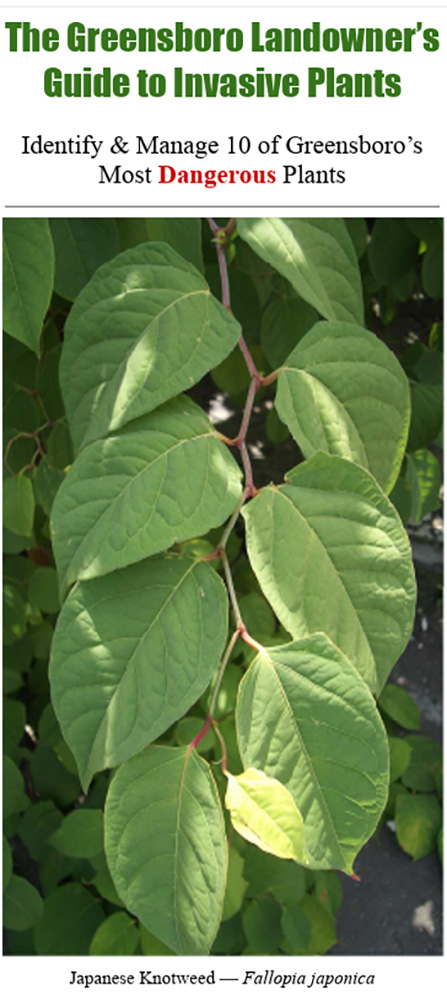
In the commission’s only recommendation for the management of Japanese knotweed (Fallopia japonica) in its brochure, titled, “The Greensboro Landowner’s Guide to Invasive Plants,” subtitled “Identify & Manage 10 of Greensboro’s Most Dangerous Plants,” is the statement “Smother for 5+ years with black plastic or tarping”
At Town Meeting Day in March 5, 2024, the GCC proposed a Pollinator Resolution which was passed by a significant majority. The resolution declares the Town of Greensboro to be a Pollinator-Friendly Community and recommends the adoption of a number of policies and practices that protect and support pollinator health by minimizing the use and sale of insecticides.
GCC members identified the product proposed for use in the knotweed pilot projects as glyphosate, an herbicide, which, because it is not an insecticide, is not covered by the Greensboro Pollinator Resolution.
In early November, Zoryan Ivakhiv-Gray, a Pollinator-Friendly Greensboro organizer, sent a message to the GCC titled, “Herbicide Application Questions and Concerns”
“I am writing about the recent decision by the Conservation Commission to contract herbicide applicators at the Highland Lodge and Smith’s Store, which was evident from your most recent meeting’s minutes. I understand, having attended a GCC meeting and been to the site, that controlling that knotweed population is important to keep the species under control, and that doing so can be challenging by mechanical means, but I am concerned that the majority of herbicides used to control knotweed may be just as dangerous (or more so) as the knotweed itself . . .”
“RoundUp and certain other chemicals used as fall stem-injection herbicides on knotweed contain Glyphosate and PFAS (Per & Polyfluoroalkyl substances), which are systemic forever chemicals, that can stay in their environment and water cycle for many years, and are easily absorbed by plant life and dispersed by water, even small quantities.”
Listing a number of concerns about the location being close to Poster Brook and dangers of chemical herbicides used to control knotweed, Ivakhiv-Gray wrote, “I question whether the use of such herbicides is worth the risk.
“According to your own GCC/Greensboro resources, Porter Brook is a spawning site for rainbow trout, brown trout, brook trout and likely sucker and smelt. Brown trout spawn in the fall (when you are considering herbicide application), and PFAS found in these herbicides can cause reproductive and immune problems and cause closure of local fisheries due to toxicity for humans as well.
“Porter Brook is an important natural area and community resource used by many other species, and flows directly into Caspian Lake, so could contaminate the rest of the lake.
“Wouldn’t it be a shame if due to our Conservation Commission, Porter Brook and Caspian lake trout fishing was closed due to high PFAS quantities in our fish, as has happened in other towns.”
“Smith’s Store is just across the road from the Lamoille River, and backs onto a wetland, both of which would be vulnerable to chemicals, especially in the event of fall flooding.” said Ivakhiv-Gray.
In conclusion, he said, “Please let me know your thoughts and further details about which herbicide is being considered.”
Before seeing Ivakhiv-Gray’s message, GCC member Chris Steel said, “The GCC is now working with other town initiatives such as the Greensboro Community Trust and the Pollinator-Friendly Greensboro Group to establish additional Pollinator beds and pathways in our town.
How the GCC responds to Ivakhiv’s concerns remains to be seen.
Editor’s note: An earlier version of this story incorrectly indicated Ivakhiv-Gray’s letter had been sent in early December.


