
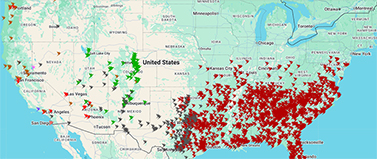


U.S. – Hummingbird Central offers crowd-sourced interactive maps tracking the northward migration of hummingbirds each spring. They had been sighted as far north as south-eastern Pennsylvania on April 4.
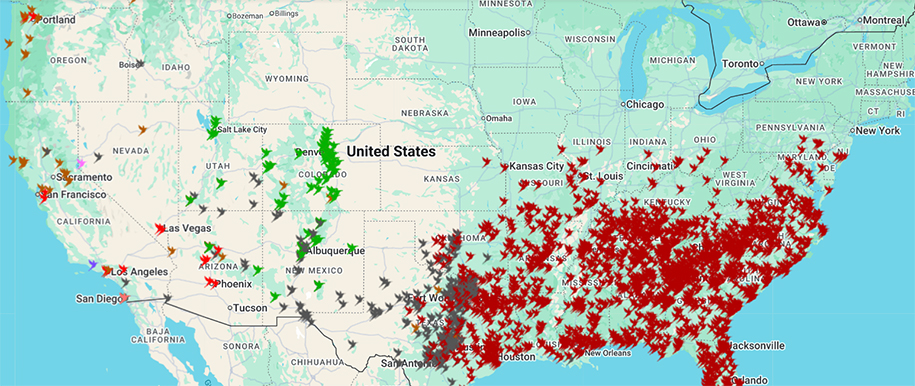
Map courtesy Google
Tracking of the annual spring hummingbird migration is done with the help of viewers as they submit their first hummingbird sightings from their locales. Each species on the map is shown in a different color with the ruby-throated most common in the east. Access the latest maps and learn more at hummingbirdcentral.com.
Many hummingbirds spend the winter in Central America or Mexico, and migrate north to their breeding grounds in the southern United States and western states as early as February, and to areas further north into Canada later in the spring.
Some, however, do not migrate, in areas like California and the upper Pacific coast, and the countries of Central America and South America.
Although there are differing views in the birding community as to what triggers the start of migration, it is generally thought that hummingbirds sense changes in daylight duration, and changes in the abundance of flowers, nectar and insects. Instinct also plays a role in making the decision to migrate.
During migration, a hummingbird’s heart beats up to 1,260 times a minute, and its wings flap 15 to 80 times a second.
To support this high energy level, a hummingbird will typically gain 25 to 40% of their body weight before they start migration in order to make the long trek over land and water.
They fly alone, often on the same path they have flown earlier in their life, and fly low, just above tree tops or water. Young hummingbirds must navigate without parental guidance.
Hummingbirds fly by day when nectar sources such as flowers are more abundant. Flying low allows the birds to see, and stop at, food supplies along the way. They are also experts at using tail winds to help reach their destination faster, consuming less energy and body fat.
Research indicates a hummingbird can travel as much as 23 miles in one day. However, during migration they may cover up to 500 miles at a time. Their average speed in direct flight is in the range of 20 to 30 mph, and up to three times that fast during courtship dives.
The spring migration can be hard on the hummingbird population as they move north from their winter homes.
Stops along the way may be for a few minutes, or a few days at more favorable locations with abundant food supplies.
Strong cold fronts moving south over the Gulf make flying difficult as the birds deal with headwinds and heavy rain, over long distances with no shelter. Food is non-existent over the open waters.
First arrivals in the spring, usually males, can be seen in Texas, Louisiana and other sites along the Gulf Coast in late January to mid-March.
As the spring progresses, sightings are reported further north, even into Canada.
Hummingbird Central typically tracks the spring hummingbird migration from late-January into May of each year, with the help of viewers as they submit their first hummingbird sightings in their areas. Sightings are also tracked in the summer and fall.
Hummingbirds are found only in the Western Hemisphere, with almost half the species living in the “equatorial belt” between 10 degrees north and south of the equator. The hummingbird family has 366 species and 112 genera, mostly south of the United States. Hummingbirds comprise the family Trochilidae, among the smallest of birds, with most species measuring in the 3 inch to 5 inch range.
Learn more about the Hummingbirds of the World, and how many species there are in North America, Central America, South America and in the islands of the Caribbean Sea at hummingbirdcentral.com/hummingbirds-of-the-world.htm.


