
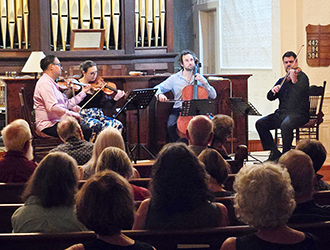

GREENSBORO – The Summer Music from Greensboro season began Tuesday evening, July 14, with a performance at the United Church of Christ by the remarkable Harlem Quartet with works by Beethoven, Lopez-Gavilan, Bolcom and Fanny Mendelssohn-Hensel.
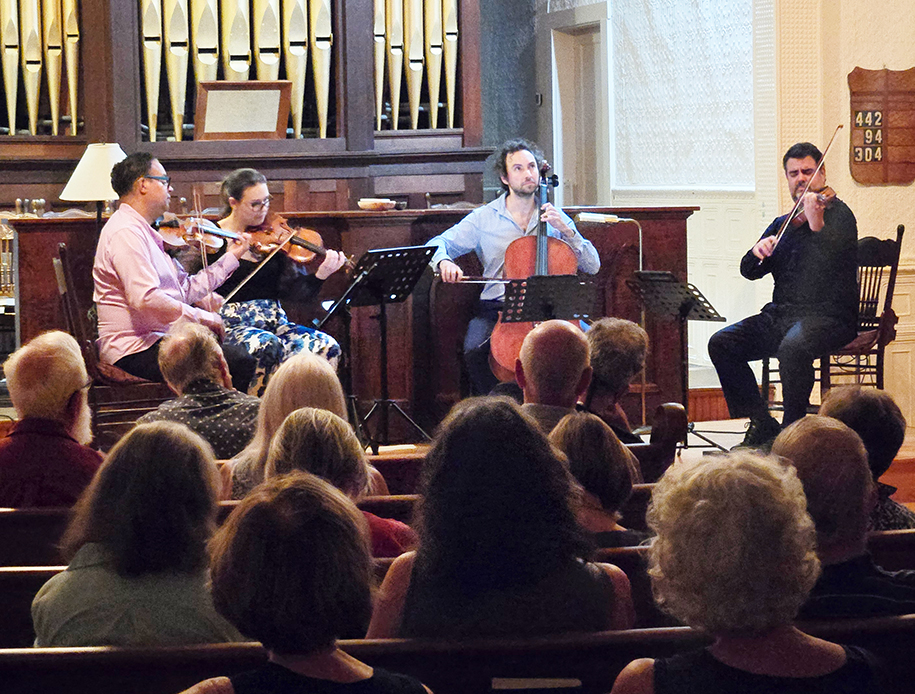
photo by Vince Illuzzi
The group consisted of Ilmar Gavilan and Amy Schroeder on violins, Jaime Amador on viola and Felix Umansky on cello, all excellent musicians. The quartet tours have included numerous colleges as well as main concert venues such as Carnegie Hall and the Kennedy Center. Equally impressive is their educational outreach to diverse communities and their extensive recordings.
The program started with the “String Quartet No. 5 in A Major, Op.18” by Ludwig van Beethoven (1770 – 1827). This is an early work, part of six quartets written in 1800, in which we hear the influence of Mozart and Haydn, the latter of whom more-or-less invented the quartet form (he wrote 68 of them) and with whom Beethoven studied in the 1790s. Curiously, Beethoven left no published juvenalia, and right from the onset his music had an originality and a pushing of the traditional boundaries.
The first movement of this quartet, an allegro, had a lively tempo in both the initial and second melodies which the players handled with exact coordination. The second section, a menuetto-trio, had dance rhythms which were well developed, while the third part, an andante cantabile con variazioni, switched to a D major mode in a stately theme with permutations, with the first violin featured and the instruments echoing each other. The final allegro-assi had a faster tempo with fine momentum but bolder outbursts and some surprising interruptions in the flow with the music stopped for powerful moments of silence, all concisely played.
The second work, “Guagunco” was written by the father of the first violinist, Guido Lopez-Gavilan (b.1944), a Cuban composer who studied in Havana and Moscow. This piece, premiered in 1985, draws on African-Cuban sources of the rumba in which the third note of the melody is delayed. It had great dance rhythms and a driving beat with lush chords, accompanied by pizzicato texture and knocking on the bodies of the instruments for percussive effects. Altogether, this piece took one along on a lively journey and made one want to hear more of this artist’s works.
After the intermission, the Harlem Quartet played “Three Rags for String Quartet,” by William Bolcom (b.1938), an American composer who studied with Darius Milhaud and at Stanford University, eventually settling in Ann Arbor, Michigan. He was instrumental in reviving, in the 1960s, the popularity of the piano rag from the turn of the Twentieth Century, African American in origin, created by Scott Joplin (1868 -1910) and others. He and his wife, Joan Morris, gave many delightful performances of classic American songs which were subsequently recorded. The first piece, the “Poltergiest Rag,” was very playful with a joyous ambiance, in the rag structure of major and minor seconds but with more contemporary slightly off notes having a humorous touch. The second selection, the “Graceland Ghost Rag,” was a love poem to his father, a portrait in music that was exquisite beyond words, two melodies of emotional depth and beauty that reached perfection. The third work was entitled ambiguously, “The Incineratorag.” which had wonderful bouncy rhythm in the first part and a slightly more subdued feeling in the second, but both with a real swing that made one want to get up and dance.
The last number on the program was the “String Quartet in E-flat Major, H. 277,” by Fanny Mendelssohn Hensel (1805-1847). She was the older sister of Felix Mendelssohn and was a talented pianist. She composed some chamber music after she was married, such as this string quartet in the years 1829-1834. The Adagio ma non Troppo began in a medium tempo and had a rich blending of the two violins, viola and cello. The Allegretto that followed had a skipping rhythm and some pizzicato passages. The third movement, a Romanze, had a more serious mood, lyrical and with more feeling in the deeper shades. The last part, Allegro molto vivace, had great momentum and with a positive flow of energy that had elements of spontaneity, intensely played by all the musicians, culminating in a triumphant ending.
In every work in the concert the Harlem Quartet demonstrated beautiful ensemble integration and they well deserved the standing ovation they received from the enthusiastic audience.
The next concert in the Summer Music from Greensboro series will be on Tuesday, July 28, at 7:30 p.m., and will feature Chris Brubeck’s Triple Play, three outstanding musicians performing folk, blues, jazz and classical pieces on a variety of instruments. For more information, go online to summermusicfromgreensboro.net.

David K. Rodgers
David K. Rodgers is a writer, mason and card carrying dilettante, who dabbles and babbles in art. He has lived in East Craftsbury for the past 40 years.


