
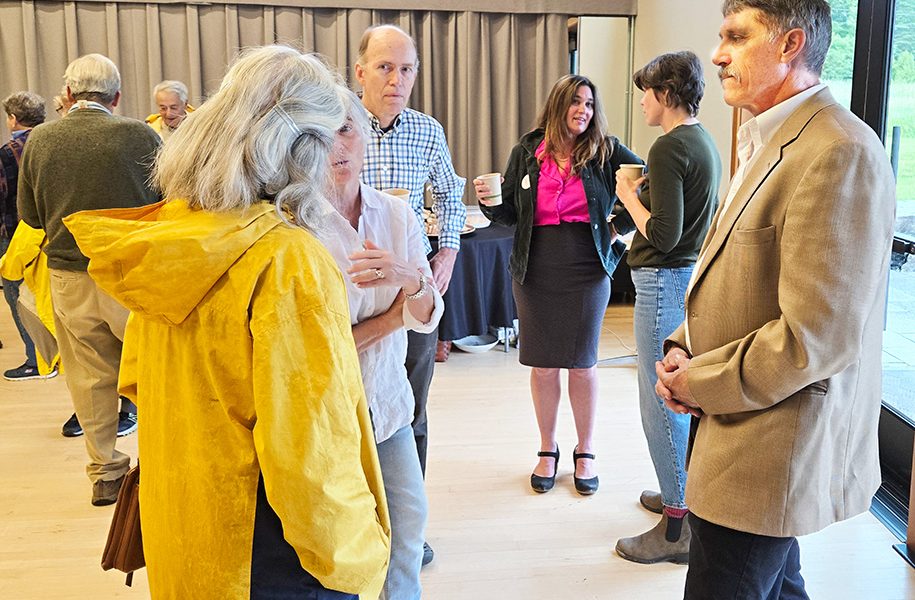

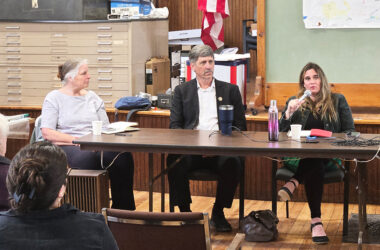
GREENSBORO – Lt. Governor John Rodgers and Representative Leanne Harple joined residents of Craftsbury, Greensboro, Albany and Glover, Saturday, June 28, for a discussion at the Highland Center for the Arts about outcomes of the 2025 legislative session and what lies ahead. After a time to ask questions, former State Representative Katherine Sims led a hands-on activity to help attendees understand the legislative process and how to help make their voices heard in Montpelier.
Liz Steel moderated the event, attended by about 30 people and organized by the Greensboro Communications Working Group and the Craftsbury Freedom and Unity Committee.
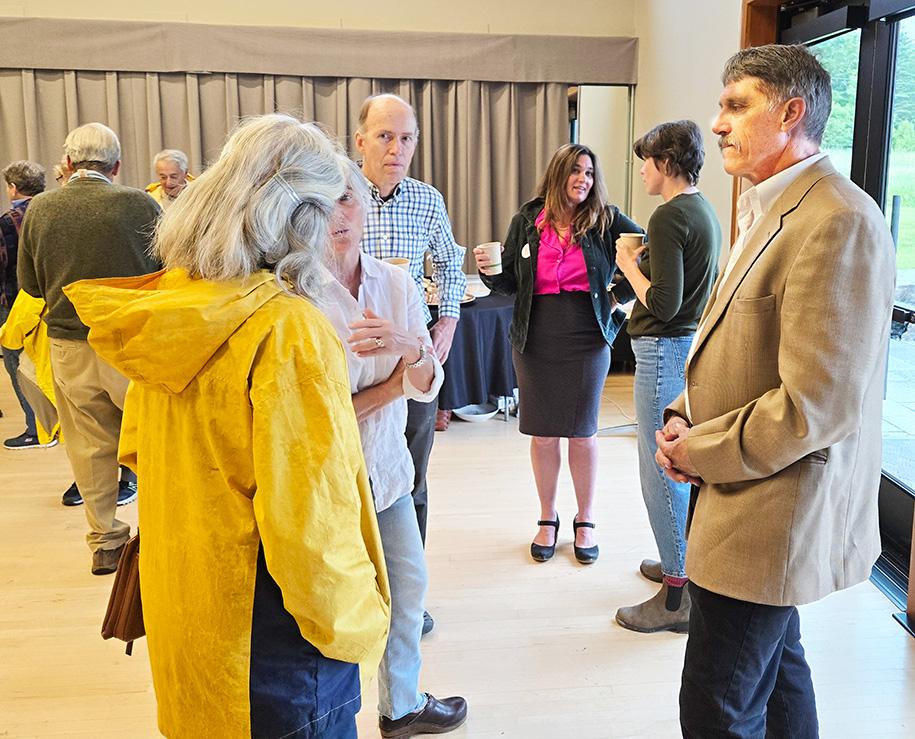
photo by Paul Fixx
Rodgers spoke first sharing that what he hears most from Vermonters is that the state is too expensive, particularly when it comes to education, housing and healthcare.
The state “hasn’t gone far enough, fast enough,” he said, telling a story about a local Center Road issue on a buildable lot where the Department of Environmental Conservation (DEC) stood in the way of issuing a permit because the planned driveway passed through a wetland.
“We can’t call everything a wetland if we’re going to solve the housing crisis,” said Rodgers.
Harple said she was glad for the great attendance and agreed with Rodgers about the housing crisis, noting that the solution requires infrastructure that most small towns don’t have.
She then turned her attention to the education bill, H.454, because of her experience as a teacher and serving on the House Education Committee, saying “there is lots of concern among Democrats” about it. The bill creates a group to propose three maps with school districts of approximately 4,000 students each from which legislators will be asked to select one. Most of the rest of the education bill will not be able to go forward if the redistricting step cannot be agreed upon.
Harple said her definition of “equity is having a school in your community” and the state’s tech centers are valuable. “Now that H.454 has passed, I don’t want to see it fail, though I am a bit skeptical,” she told the audience.
“The cell phone free bill passed” to keep them out of all schools, she said, expecting it will reduce power struggles between teachers and students.
During the question and answer period that followed Dr. Renée Rossi noted more of those in the room were older and Greensboro has the oldest average age of any town in the state. She said not a lot of younger people are civically engaged and wondered about solutions.
Rodgers said “We’ve failed to create an environment in which high school graduates can live the American dream.” It’s about demographics, with many young people leaving the state, he said. “We need to spend more to attract young people into trade school,” creating opportunities for apprenticeships, “engaging middle school kids in technical careers.”
Harple offered a different perspective, saying, “young people are engaged and need to be asked to participate” in civic activities.
In response to a question from Mary White about flood mitigation and treating tradespeople better, Rodgers said there’s a stigma faced by trade school students, but it’s a viable career path, incurring less student debt. He also mentioned the work of Migrant Justice and that groceries would be more expensive without migrant labor.
Harple said she thinks the tide is turning, with schools celebrating students who attend Green Mountain Technology and Career Center (GMTCC) and go into tech. careers. She added the regular state budget included some funds for flood mitigation.
David Kelly brought up the subject of wakeboats, with Rodgers saying he supports bans on most lakes and Harple agreeing, except to allow them on Lake Champlain, with the state adding an option for towns to ban them. Rodgers noted “it’s a rich person’s sport, with wakeboats costing over $100,000. Rodgers said people can make comments on the Agency of Natural Resources (ANR) website and ask others to do so, in response to a question from Charlie Peck.
The questions wrapped up with a comment from Scott Rhodewalt about how to share wealth in a more equitable way, particularly with the amount spent nationally on the defense budget and war. Rodgers bemoaned the state’s disheartening lack of influence on federal policy. “Vermont income taxes are fairly progressive now, but people can go elsewhere and income sensitivity is benefitting some who hide their income,” he said.
Harple came back to the education tax, suggesting more progressive taxes would result if non-education expenses incurred by schools were shifted out of the education budget to the general budget. She wrapped up her comments saying there’s a mental health crisis in the last five years that requires attention.
As some of those gathered left, or took the opportunity to talk directly with Rodgers and Harple, about 20 people stayed as Sims shared her observations about the focus of federal, state and local governments.
Organizers provided a wide range of refreshments at the event.

Paul Fixx is editor of The Hardwick Gazette and lives in Hardwick.


