
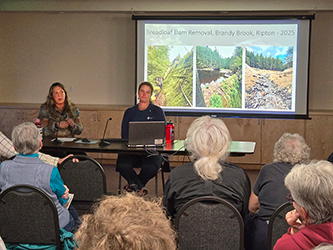

HARDWICK – A roomful of people in the Jeudeview Memorial Library’s Parker Ladd Community joined panelists Karina Dailey with the Vermont Natural Resources Council and Kassia Randzio with the Vermont River Conservancy for the third forum in the Ripple Effects series, titled “Dam Removal & Rivers,” Wednesday, Sept. 24.
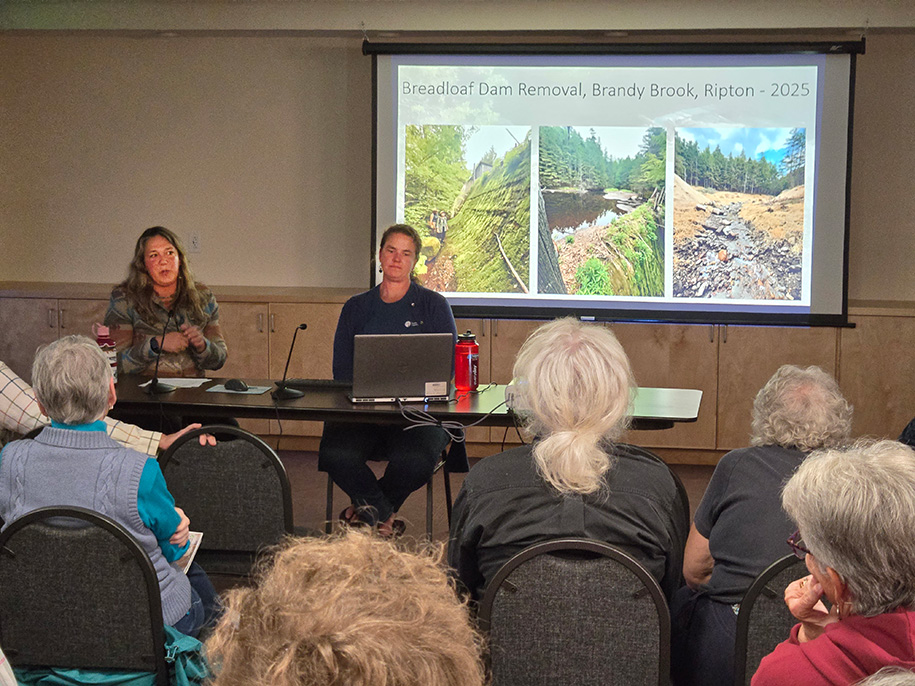
photo by Paul Fixx
Panelists shared information about a Vermont Dam Removal Initiative that has resulted in 72 dams removed of the more than 1,000 in the state. The initiative is designed to raise awareness, identify derelict dams, prioritize potential projects to remove unnecessary dams and collaborate with all of the stakeholders during discussion of potential dam removal projects.
They gave an overview of river science and talked about how dams disrupt a river, degrade water quality and the aquatic habitat, restrict the movement of fish and other wildlife and can be a liability to landowners, as well as a public safety risk.
They explained the difference between run of the river dams that simply pass the same amount of water as is coming in, with a steady flow in and out, depending on what the weather brings. Those dams provide minimal flood protection, disconnecting the river from its pre-dammed watershed.
Flood control dams and those generating electric power offer dynamic storage, which can allow them to hold water back during storms, then later releasing is slowly. Because they have a key role in protecting communities they must be well-maintained and closely monitored.
Mention of a simple 10-step process for dam removal drew a laugh from the audience because nothing about it is simple. Six steps are involved before dam removal can even begin. They start with project selection, developing support, fundraising, design, permitting and further outreach before removal begins. Following removal of a dam. restoration of the area and surrounding habitat is required, along with monitoring and, most importantly, time, they said.
Examples of work on Winooski River dams near Montpelier illustrated their points.
While the presentations weren’t about the removal of any particular dams in the Hardwick area, most questions following the presentation were about Hardwick’s Jackson dam on Wolcott Street, just before its intersection with Route 14 North and Route 15 West next to The Kwik Stop gas station and mini-mart. Close behind were concerns about the Shadow Lake dam, where the water level has been lowered significantly due to concern about the dam’s integrity
The final Ripple Effects forum, titled, “”Climatology and the Future of Vermont’s Watersheds – Including the Impacts of Drought” happens this week, on Wednesday, Oct. 1, from 6 to 7:30 p.m. in the Parker Ladd Community Room at the Jeudevine Memorial Library.
Lesley-Ann L. Dupigny-Giroux, Ph.D., Professor and Vermont State Climatologist and Current Chair of the Vermont Drought Task Force will have a presentation, followed by community Q&A. Light snacks will be provided.
The event is being sponsored by the Town of Hardwick in collaboration with Sea Grant Lake Champlain, the Caledonia County Natural Resources Conservation District, NVDA and the Vermont Department of Environmental Conservation, River Corridor & Floodplain Protection Team.
The four-part forum series invites the community to explore how water connects us and how we can work together for a more resilient future.
All are welcome. No registration required.
For questions, contact Kristen Leahy, Resilience & Adaptation Coordinator at (802) 472-1686 or zoning.administrator@hardwickvt.gov

Paul Fixx is editor of The Hardwick Gazette and lives in Hardwick.


