
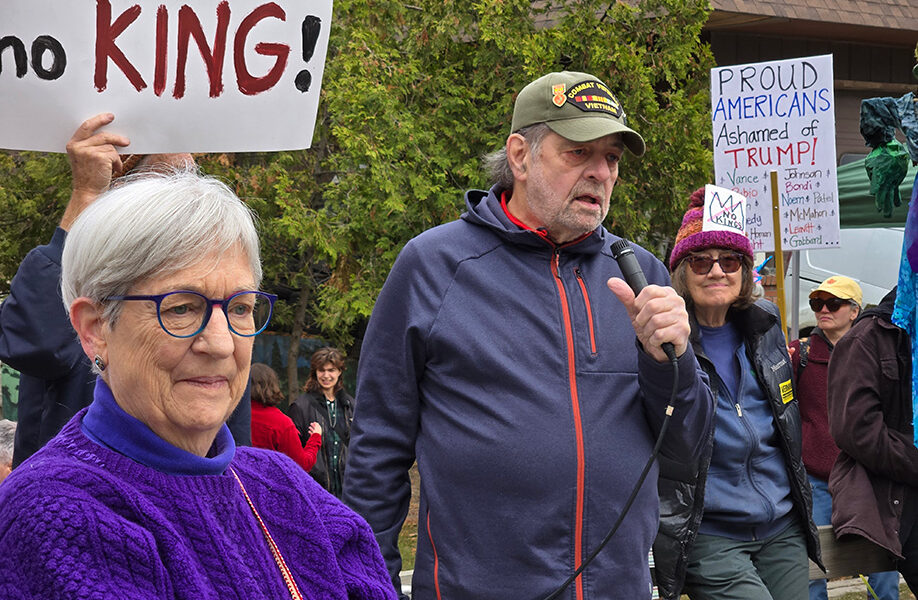



HARDWICK – At least 286 people rallied and protested in downtown Hardwick Saturday, on No Kings Day 2. Some were waving signs challenging actions of the federal government and the President. Others draped themselves in rainbow colors, with one wearing a unicorn costume to call out divisive rhetoric, suggesting radical acceptance instead.
Almost 200 residents and out-of-town visitors gathered at Hardwick’s Fire Station last October 18, at 10 a.m., for the day’s events. The half-hour rally served as a send-off for about 75 people who left on a bus, and in carpools, to join a noon gathering at Vermont’s Montpelier Statehouse.
Hardwick’s John Helms counted 117 people who then marched toward S. Main Street, where they joined others who lined both sides of the street, from Front Seat Coffee to the Hardwick Inn.
A downtown rally at Hardwick’s Peace Park was kicked off by Jan Mueller, who said, “It’s about showing up.”
After the two groups joined up, others continued to arrive, bringing the total to at least 286, as counted by Helms.
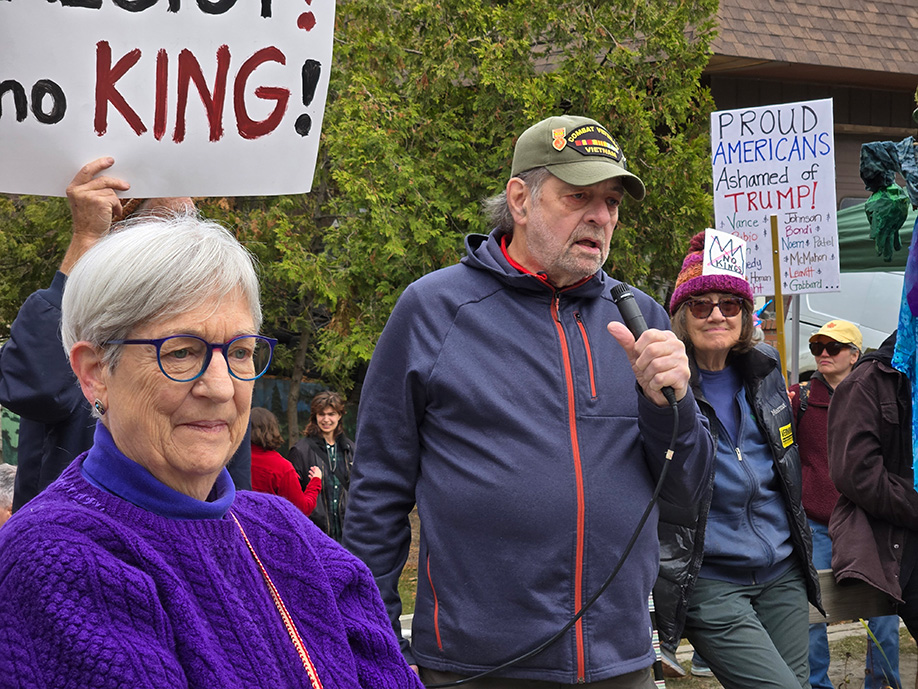
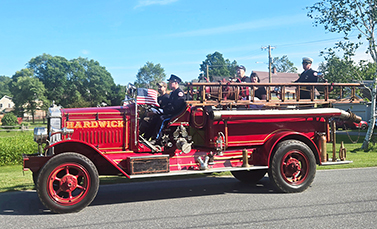
photo by Paul Fixx
At the Peace Park, remarks by Carlotta Hayes, a driving force behind Hardwick’s Indivisible group, introduced former state Rep. Chip Troiano.
Troiano shared a story about being sent into Washington D.C. with a squad of other soldiers, recently returned from Vietnam. Armed with loaded military rifles, they were ordered into the city’s streets to quell rioters who were responding to Martin Luther King’s recent assassination. His group decided it was not appropriate to turn their weapons on fellow citizens.
Instead, they patrolled the streets, warning rioters it wasn’t safe on the streets, directing and escorting them home; to relative safety.
Troiano said, by offering respect to the city’s citizens, they were given respect.
A good percentage of cars are trucks traveling through town honked mostly in support, though a few squealed tires and revved engines, in apparent opposition to the gathering. The occupant of one truck exclaimed, “We need king Trump,” and another, “All hail king Trump.”
Walden’s Jeff Pierpont was introduced, saying, “I’m here today because I believe in democracy, not autocracy.
“This country was never meant to be ruled by an autocrat. It was founded on the radical idea that ‘we the people’ hold the power. That leadership is service, not entitlement.”
Saying, “What we’re watching unfold isn’t politics as usual, it’s a full-scale attempt to replace democracy with authoritarianism,” Pierpont then listed recent reversals of U.S. Government policy: bills that seem written by billionaires and border agents, healthcare stripped from millions, funding slashed for schools and SNAP programs.
“This isn’t just about one man with a gold-plated office,” he said.
“It’s about a system rigged to benefit the wealthy, the connected, and the cruel.”
“And it’s about a dangerous lie; that some lives matter more than others: that some voices should be silenced, that some families can be discarded,” Pierpont continued.
“But we’re not here because we are afraid. We’re here to raise our voices. To live in truth.”
“We cannot accept the lies,” he said.
“We can name them, challenge them, and even better, disrupt them. We can be bold and nonviolent. We can confront falsehood with art, with absurdity, with dignity and defiance.”
In conclusion, Pierpont said, “We believe in a future where power is shared, not seized. Where justice is real. Where democracy is more than a word: it’s the work all of us do together.”
The gathering continued for another hour, with Allison Belisle of Brookfield, who stood in the no parking zone on the street near Front Seat Coffee, saying she and her partner came to Hardwick for No Kings Day 2, and the first No Kings Day, June 14, because they felt their presence would make more difference here than in Montpelier.
“There’s more exposure at the intersection of Vt. Rtes. 14 and 15 than almost anywhere else in rural Vermont.”
A pair of costumed relatives from Albany, who asked not to be identified because of the work one of them is involved with, dressed as a unicorn and some sort of four-legged blue creature and said they wanted to add their voices to the event.
“A president steeped in constitutional lore might have been offended by claims he’s acting as a king,” reported CNN on Sunday.
“But Donald Trump and his entourage responded with mockery to weekend ‘No Kings’ protests by millions of Americans, embracing the narrative in a way that explains his growing hubris and belief that he has unchecked power.”
The Atlantic said Monday, “Say what you will about Donald Trump’s effect on American civic life as a whole, but he’s done wonders for public participation. Voter turnout in the past few elections has reached record highs, for example. And after Saturday’s ‘No Kings’ marches, three of the largest one-day demonstrations in American history have taken place during Trump’s two presidencies.”
After the downtown Hardwick rally, a small group gathered in the Hardwick Peace Park to review the day’s activities, recruit future organizers and make plans for future events.
They noted the day’s visitors included those from Cabot, Eden, Walden, Albany, Brookfield, East Hardwick and a large Woodbury contingent. Nearby events had been held in Morrisville, Newport, Wolcott, Montpelier and St, Johnsbury, where it was estimated that 700 people showed up.
Regular honk and wave events are scheduled at 10 a.m., Tuesday, at Hardwick’s Peace Park to highlight Indivisible’s big-tent, pro-democracy, non-partisan movement, said organizers. Another gathering, 7 p.m., Thursday, at GRACE, is geared more toward Indivisible Hardwick’s movement organizing, with anyone interested in learning more welcome to attend.

Paul Fixx is editor of The Hardwick Gazette and lives in Hardwick.


I’ve tried to speak with a great many people on both sides of this issue. Not a single person could tell me what EXACTLY has been done that was anything remotely resembling any monarch. In fact, everything that was put forth was well within the legal and Constitutional limits imposed by our representative republic. Nor could anyone document how it is that America is any sort of a democracy. The only thing that anyone on either side of this issue could decribe that was unconstitutional, was how Kamela Harris ended up on a national ballot without ever recieving a single vote to get on said ballot. Please explain to me how it was that she was appointed to be on the ballot. Who decided? How was that Constitutional? And that’s a serious question. While people are out attempting to label Trump many things without any real articulatable justification for any of those labels. They seem unable to grasp that Vice President Harris being appointed to be on the ballot, was EXACTLY what they are saying President Trump is trying to do, usurp our electoral process. So please tell me how her appointment was not doing what they are assigning to others, yet refusing to acknowlege was done by the Democratic party in getting her on the ballot at all without a single vote from the populace to do so.
Yours is a curious comment. What does “trying to speak” look like?
Had you asked me, the response would have looked a lot like AI generated info below, which I’ve read and essentially agree with.
Before that, my answer to your Harris question is that any party recognized by a state can submit a candidate followung any process they agree on within their party. There are other ways to get on the ballot. Judge that however you like. But what happened with Harris
seems perfectly legal.
Now for the answer to your monarchy question.
In recent years, commentators, scholars, and political opponents have drawn parallels between Donald Trump’s presidency and a monarchy. They have pointed to his challenges to the U.S. constitutional system of checks and balances, his use of executive power, his rhetoric, and the loyalty demanded from those around him as key areas of resemblance to monarchical or authoritarian rule.
Challenges to checks and balances
Critics have accused Trump of undermining the constitutional separation of powers, which was established to prevent the presidency from becoming a monarchy.
Executive authority: Trump has been seen as arguing for the right to control the executive branch without interference from Congress or the judiciary, a view compared to the absolutism of medieval monarchs. Project 2025, an initiative with which Trump is associated, has been described as a blueprint for expanding presidential authority in a potential second term.
Congressional oversight: Trump has been accused of attempting to circumvent Congress’s power of oversight and spending authority, using unilateral actions to achieve his goals. Examples include circumventing Congress on federal spending and threatening to withhold federal funding to force policy changes.
Subverting independent agencies: His administration has taken steps to bring independent federal agencies under direct presidential control by firing agency leaders without cause and requiring them to report to the White House.
Ignoring the judiciary: The Campaign Legal Center documented instances where the Trump administration ignored court orders and attempted to undermine the power of the judiciary to hold the executive accountable.
Assertion of power and use of the justice system
Several actions related to the assertion of power have been compared to the unilateral decisions of a monarch:
Politicizing the DOJ: A Center for American Progress report accused Trump of weaponizing the Department of Justice for political purposes, such as investigating political opponents. The firing of federal employees and the use of the justice system to punish perceived enemies has been cited as an abuse of power.
Issuing mass pardons: Trump’s use of preemptive pardons for allies has been likened to the power of a king to pardon friends without restriction.
Displaying impunity: A decision by the Supreme Court in 2024 to grant presidents sweeping immunity for official acts was seen by some as enabling a presidential monarchy.
Deploying federal agents: The administration has been criticized for threatening the sovereignty of states and cities by deploying federal agents and the National Guard to stifle dissent.
Rhetoric and personality cult
Trump’s language and the expectations of his supporters have been viewed through a monarchical lens.
Possessive pronouns: Analysts have pointed to Trump’s frequent use of possessive language—referring to “my generals,” “my attorney general,” and “my Supreme Court”—as evidence of a personal, monarchical self-image.
Divine right: Critics have noted his rhetorical framing of the presidency as a position granted by divine will, an idea often associated with royal power. The comparison was reinforced by a fake magazine cover posted by the White House depicting Trump as a king.
Celebrity and spectacle: Commentators have compared Trump’s cultivation of celebrity and spectacle, including extravagant events and social media messaging, to historical European courts like that of Louis XIV.
Demanding personal loyalty: The emphasis on personal allegiance over fidelity to the Constitution, demanding loyalty from officials, and attacking those who oppose him echoes the dynamics of a royal court.
Hereditary succession and financial interests
The concept of a monarchy as a dynastic family enterprise has also been raised by critics.
Nepotism: Trump’s appointment of his daughter, Ivanka, and son-in-law, Jared Kushner, to high-level White House positions led to accusations of nepotism and ethical conflicts.
Enriching the family: His refusal to divest from his business holdings created an unprecedented stream of conflicts of interest. Critics have documented instances where he used the presidency for personal financial benefit and to enrich his family.
Succession planning: An opinion piece in the Asheville Citizen Times noted that Trump “lays plans to keep the kingdom in his family forever more” by preparing one or more of his children to potentially inherit his political mantle.
Thank you for at least attempting to engage in the discussion rather than dismiss those who may feel diferently.
First, I’d like to note that opinions, protests, court actions, talking heads on TV, screaming people who feel somehow slighted are in no way necessarily factually, nor legally based. Nor should they be given the weight of law. I do find it interesting that your response is not really your response at all. Asking a computer to formulate your opinions seems more than a little dangerous. As well as somewhat disingenious. All you have done is let a computer summerize allegations. That you asked AI what you think is troublesome at best.
Yet somehow, despite all of the misinformation and allegations, our system of checks and balances still hold. Allegations that the Trump administration acts like a monarchy are not only exaggerated, they ignore the very structure of our Constitutional Republic.
Every executive action taken by President Trump was and is subject to judicial review and congressional oversight. Courts have blocked or modified many of his initiatives, and Congress has exercised its power through investigations and even impeachment. Monarchs don’t get impeached, presidents do. Elections worked. Trump was elected through a democratic process and left office after losing the 2020 election. The peaceful transfer of power, though contentious, ultimately occurred. Midterm elections shifted control of the House, limiting executive power. That’s our Constitution in action.
Executive orders aren’t royal decrees. Every modern president uses them, from Obama to Bush to Clinton. They’re legal tools within constitutional bounds, not signs of tyranny.
The press has criticized Trump relentlessly. Citizens protested, organized, and voted. In a monarchy, dissent is silenced. In America, it’s amplified. Calling the Trump administration a monarchy may feel cathartic to critics, but it’s constitutionally inaccurate. The system held. The republic endured. Without ever having resorted to becoming a democracy. I would agree that my definition of a democracy may differ from the rhetoric being used, in that to me, democracy is mob rules. And there are certainly those on both sides who seem to believe it should be exactly like that. I’m grateful it is not. Nor should it ever be.
Again, thank you for at least taking the time to respond. Albeit with a computer generated synopsis of the allegations. Thank you for at least engaging.